

Choosing between a Data Analyst vs Business Analyst vs BI Analyst Australia is one of the most common questions we hear from people starting out and it’s a fair one, because the job titles genuinely overlap on paper. Australian organizations are becoming more data-driven every year, which means demand for all three roles keeps climbing, but the actual day-to-day work behind each title is quite different.
In short:
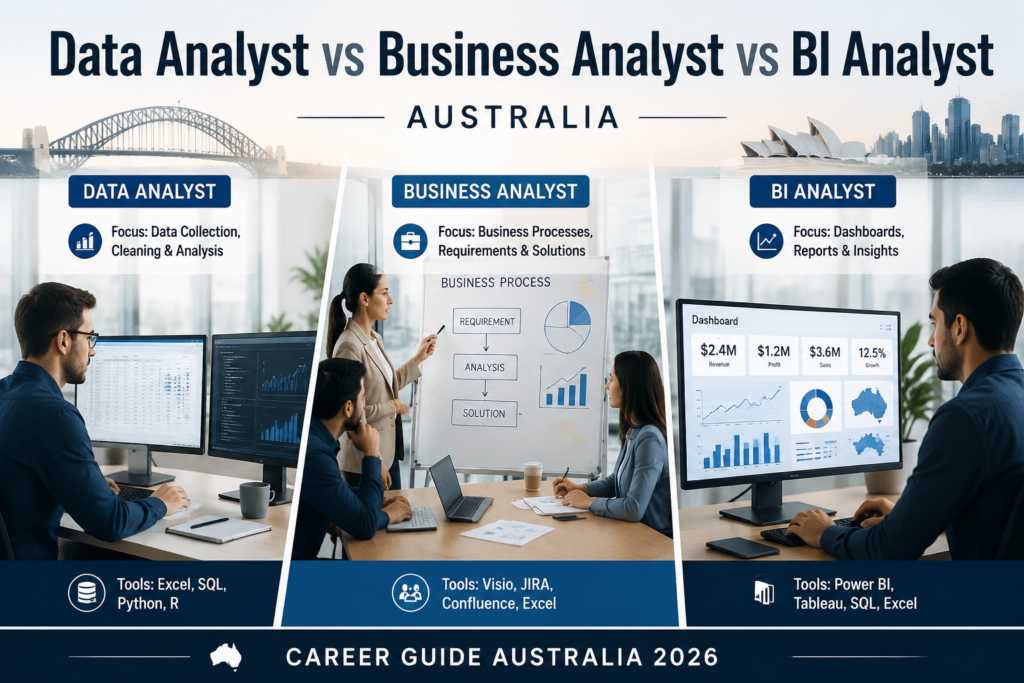
- A Data Analyst focuses on analysing data and finding insights.
- A Business Analyst focuses on business problems, requirements and process improvement.
- A BI Analyst focuses on dashboards, reporting and business intelligence tools.
The Australian Bureau of Statistics describes Data Analysts as professionals who collect, process, analyse and interpret data, then communicate insights through reports and visualisations. Microsoft describes Power BI as a business intelligence platform that helps organisations connect governed data, trusted metrics and interactive insights for faster decision-making. This guide walks through what each Australian analyst role actually involves, so you can work out which one fits you.
Quick Comparison: Data Analyst vs Business Analyst vs BI Analyst
In plain terms:
- Data Analyst = works with data to find insights.
- Business Analyst = works with people and processes to solve business problems.
- BI Analyst = builds dashboards and reporting systems for decision-making.
| Role | Main Focus | Best For | Common Tools |
|---|---|---|---|
| Data Analyst | Data analysis, trends, insights | People who enjoy numbers, patterns and problem-solving | SQL, Excel, Python, Power BI, Tableau |
| Business Analyst | Requirements, processes, stakeholder needs | People who enjoy communication, business improvement and documentation | Excel, Jira, Confluence, Visio, PowerPoint |
| BI Analyst | Dashboards, reporting, data models | People who enjoy visual reporting and performance tracking | Power BI, DAX, SQL, Excel, Tableau |
What Does a Data Analyst Do in Australia?
A Data Analyst in Australia turns raw data into insights that help a business make better decisions. It’s less about pulling numbers together and more about explaining what those numbers actually mean.
Typical responsibilities include:
- Collecting and cleaning data
- Analysing trends and patterns
- Creating charts and reports
- Writing SQL queries
- Using Excel, Python or R
- Building simple dashboards
- Presenting findings to stakeholders
- Supporting business decision-making
The ABS states that Data Analysts analyse and interpret data to describe trends and patterns, solve problems and answer data-related questions, and that they communicate findings through reports and data visualisations such as charts and infographics. That mix of technical work and clear storytelling is what makes a Data Analyst career path in Australia appealing to people who like both numbers and explaining them.
What Does a Business Analyst Do in Australia?
Data Analyst vs Business Analyst vs BI Analyst Australia acts as the bridge between business stakeholders and technical teams. Where a Data Analyst asks what the data shows, a Business Analyst asks what the business actually needs.

Typical responsibilities include:
- Gathering business requirements
- Documenting processes
- Identifying business problems
- Writing user stories
- Supporting Agile projects
- Mapping current and future-state processes
- Communicating with stakeholders
- Helping teams deliver business change
Business Analysts are usually less focused on coding and more focused on understanding business needs, improving processes and supporting project outcomes which makes this Business Analyst career path in Australia a strong fit for people who lead with communication rather than technical depth.
What Does a BI Analyst Do in Australia?
A BI Analyst focuses on business intelligence, dashboards, management reporting and KPI tracking. If a Data Analyst finds the insight, the BI Analyst is often the one who makes it visible to the whole organisation, every day, automatically.
Typical responsibilities include:
- Building dashboards
- Creating Power BI reports
- Designing data models
- Writing DAX measures
- Connecting data sources
- Automating recurring reports
- Tracking KPIs
- Supporting executives with visual insights
Microsoft describes Power BI as a platform for creating interactive visuals, trusted semantic models and business intelligence experiences that help teams make decisions faster, and notes that Power BI Desktop lets analysts import data, shape it, create relationships, build reports and publish them which is essentially the daily toolkit of a BI Analyst in Australia.
Data Analyst vs Business Analyst vs BI Analyst: Key Differences
Difference in Daily Work
- Data Analyst: spends more time analysing datasets.
- Business Analyst: spends more time with stakeholders and requirements.
- BI Analyst: spends more time building dashboards and reports.
Difference in Technical Skills
- Data Analyst: SQL, Excel, Python, statistics, data cleaning.
- Business Analyst: Excel, process mapping, requirements documentation, Agile tools.
- BI Analyst: Power BI, SQL, DAX, data modelling, dashboard design.
Difference in Business Focus
- Data Analyst: What happened and why?
- Business Analyst: What does the business need to improve?
- BI Analyst: How can we track and report performance clearly?
Difference in Career Personality Fit
- Data Analyst: analytical and detail-oriented.
- Business Analyst: communication-focused and business-minded.
- BI Analyst: visual, technical and reporting-focused.
Skills You Need for Each Career Path
Data Analyst Skills
- SQL
- Excel
- Python
- Statistics
- Data cleaning
- Data visualisation
- Problem-solving
- Business reporting
- Communication
Business Analyst Skills
- Stakeholder management
- Requirements gathering
- Business process mapping
- Agile and Scrum
- User stories
- Documentation
- Communication
- Problem-solving
- Workshop facilitation
BI Analyst Skills
- Power BI
- DAX
- Power Query
- SQL
- Data modelling
- Dashboard design
- KPI reporting
- Data storytelling
- Excel
- Business intelligence
Tools Used by Data Analysts, Business Analysts and BI Analysts
Data Analyst Tools
- Microsoft Excel
- SQL
- Python
- R
- Power BI
- Tableau
- Google Analytics
- Jupyter Notebook
Business Analyst Tools
- Microsoft Excel
- Microsoft Visio
- Jira
- Confluence
- Microsoft PowerPoint
- Miro
- Lucidchart
- Azure DevOps
BI Analyst Tools
- Microsoft Power BI
- Power Query
- DAX
- SQL Server
- Tableau
- Microsoft Fabric
- Excel
- Data Warehouse platforms
Microsoft says Power BI can connect to data from cloud and on-premises sources, create a single source of truth, and enable governed insights through Microsoft Fabric and OneLake which is why BI Analyst roles increasingly expect at least some familiarity with the wider Fabric ecosystem, not just Power BI Desktop.
Salary Outlook in Australia in 2026
Salaries for all three roles vary by location, experience, industry and contract type, so treat the figures below as a general guide rather than a guarantee.
Data Analyst Salary in Australia
Data Analyst salaries in Australia commonly vary by experience, with higher salaries often found in industries such as finance, healthcare, government, technology and consulting.
Business Analyst Salary in Australia
SEEK’s 2026 salary data shows that Business Analyst salaries are particularly strong in Information & Communication Technology, Banking & Financial Services, Insurance & Superannuation, Government & Defence and Consulting.
BI Analyst Salary in Australia
SEEK’s 2026 data lists Information & Communication Technology and Government & Defence among the highest-paying industries for Business Intelligence Analyst roles.
Which Career Path Is Best for Beginners?
Choose Data Analyst If You Like Data and Numbers
Best for people who enjoy:
- Working with spreadsheets
- Finding patterns
- Solving data problems
- Learning SQL or Python
- Creating reports
Choose Business Analyst If You Like People and Processes
Best for people who enjoy:
- Talking to stakeholders
- Understanding business problems
- Writing requirements
- Improving processes
- Working on projects
Choose BI Analyst If You Like Dashboards and Visual Reporting
Best for people who enjoy:
- Power BI
- Dashboards
- KPI reporting
- Data visualisation
- Business performance tracking
Which Career Is Best for Career Changers in Australia?
Career changers can move into any of the three roles, but the best starting point usually depends on your existing background.
If You Come from Administration or Operations
Recommended path: Business Analyst, then BI Analyst, then Data Analyst.
Why: admin and operations professionals often already understand processes, reporting and stakeholders.
If You Come from Finance or Accounting
Recommended path: Data Analyst, then BI Analyst, then Business Analyst.
Why: finance professionals often already use Excel, reporting, budgets and metrics.
If You Come from IT or Software Support
Recommended path: Business Analyst, then BI Analyst, then Data Analyst.
Why: IT professionals often understand systems, users, requirements and technical workflows.
If You Come from Marketing or Sales
Recommended path: Data Analyst, then BI Analyst, then Business Analyst.
Why: marketing and sales professionals often work with customer data, campaign metrics and dashboards.
Data Analyst vs Business Analyst vs BI Analyst: Which Is More Technical?
Ranking from least technical to most technical: Business Analyst, then BI Analyst, then Data Analyst.
A Business Analyst usually needs enough technical understanding to communicate with IT teams, but the role is not always hands-on with coding. A BI Analyst is more technical because they often build data models, dashboards and automated reports. A Data Analyst can be the most technical of the three if the role requires SQL, Python, statistics, data cleaning and advanced analytics.
Which Role Has the Best Future in Australia?
All three roles have strong future potential in Australia, but each is evolving in a slightly different direction:
- Data Analysts will need stronger AI, automation and storytelling skills.
- Business Analysts will need stronger digital transformation and Agile skills.
- BI Analysts will need stronger Power BI, data modelling and governance skills.
Jobs and Skills Australia provides occupation and industry data to support evidence-based workforce and training planning across the country, and the ABS has modernised Australia’s occupation classification through OSCA to better reflect changes in the labour market, including technology and emerging occupations.
Best Certifications for Each Analyst Career
Data Analyst Certifications
- Microsoft Certified: Power BI Data Analyst Associate
- Google Data Analytics Certificate
- IBM Data Analyst Professional Certificate
- SQL certifications
- Python data analytics courses
Business Analyst Certifications
- ECBA
- CCBA
- CBAP
- Agile Business Analyst certifications
- PRINCE2 Foundation
- Scrum Master certification
BI Analyst Certifications
- Microsoft Certified: Power BI Data Analyst Associate
- Power BI courses
- Tableau certification
- SQL certification
- Microsoft Fabric training
- Data modelling courses
Recommended Learning Path for Australia in 2026
Beginner Level
- Excel
- Data basics
- Business reporting
- Basic SQL
- Dashboard fundamentals
Intermediate Level
- Power BI
- Power Query
- Data cleaning
- Requirements gathering
- Process mapping
- Stakeholder communication
Advanced Level
- DAX
- Python
- Advanced SQL
- Data modelling
- Agile delivery
- Data governance
- Executive reporting
Which Career Path Should You Choose?
Choose Data Analyst If…
- You enjoy working with data
- You like solving analytical problems
- You want to learn SQL or Python
- You prefer insights and evidence-based decision-making
Choose Business Analyst If…
- You enjoy working with people
- You like solving business problems
- You are good at communication
- You want to work across projects, systems and processes
Choose BI Analyst If…
- You enjoy dashboards and reports
- You like visual storytelling
- You want to specialise in Power BI
- You enjoy turning data into business performance insights
Common Mistakes When Choosing an Analyst Career
- Choosing Data Analyst only because it sounds technical
- Choosing Business Analyst without understanding stakeholder work
- Choosing BI Analyst without learning data modelling
- Ignoring SQL
- Relying only on certificates without portfolio projects
- Not building Australian-style resume examples
- Not practising case studies or interview scenarios
- Confusing dashboards with real analysis
Portfolio Projects to Help You Get Hired
Data Analyst Portfolio Ideas
- Sales trend analysis
- Customer churn analysis
- COVID or public data analysis
- Financial performance dashboard
- Marketing campaign analysis
Business Analyst Portfolio Ideas
- Business requirements document
- Process map
- Gap analysis
- User stories and acceptance criteria
- Stakeholder communication plan
BI Analyst Portfolio Ideas
- Power BI sales dashboard
- Executive KPI dashboard
- Operations dashboard
- Finance reporting dashboard
- HR analytics dashboard
Final Verdict: Data Analyst, Business Analyst or BI Analyst?
If you enjoy data, statistics and technical problem-solving, choose Data Analyst.
If you enjoy business processes, people and project work, choose Business Analyst.
If you enjoy dashboards, reporting and visual insights, choose BI Analyst.
For many professionals weighing up Data Analyst vs Business Analyst vs BI Analyst careers in Australia, the smartest pathway is to start with Excel and SQL, learn Power BI, then choose whether to move deeper into data analytics, business analysis or business intelligence in Sydney, Melbourne, Brisbane, Perth, Canberra or anywhere else in Australia.
FAQs About Data Analyst vs Business Analyst vs BI Analyst in Australia
Is a Data Analyst the same as a Business Analyst?
No. A Data Analyst focuses more on analysing data, while a Business Analyst focuses more on business requirements, processes and stakeholder needs.
Is a BI Analyst the same as a Data Analyst?
Not exactly. A BI Analyst focuses more on dashboards, reporting and business intelligence tools, while a Data Analyst may focus more on deeper analysis, trends and statistical insights.
Which is better: Data Analyst or Business Analyst?
Neither is automatically better. Data Analyst is better if you enjoy technical analysis, while Business Analyst is better if you enjoy communication, processes and project work.
Is Power BI enough to get a BI Analyst job in Australia?
Power BI is very important, but most BI Analyst roles also require SQL, data modelling, DAX, dashboard design and business reporting skills.
Which analyst role is easiest to start with?
Business Analyst may be easier for people with business or operations experience. Data Analyst may be easier for people with Excel, maths or reporting experience. BI Analyst may be easier for people who enjoy Power BI and dashboards.
Do I need coding to become a Business Analyst?
Usually no. Business Analysts may need technical awareness, but most roles focus more on requirements, stakeholders, processes and documentation.
Do I need Python to become a Data Analyst?
Python is useful, but many entry-level Data Analyst roles start with Excel, SQL and Power BI.
Call to Action
Not sure which analyst career is right for you?
Start with Excel, SQL and Power BI, then build your pathway into Data Analytics, Business Analysis or Business Intelligence based on your strengths and career goals.