


If you are preparing for data analyst interview questions in Australia, 2026 is shaping up to be one of the most competitive years yet for analytics talent. Employers in Sydney, Melbourne, Brisbane, Perth, Adelaide and Canberra are hiring data analysts across banking, retail, healthcare and government, and most interview loops now blend SQL, Excel, Power BI, statistics and behavioural questions in a single process. This guide walks through the exact data analyst interview questions and answers candidates are seeing right now, so you can walk into your interview prepared rather than guessing.
Why Data Analyst Interview Questions Matter More in 2026
Australian businesses are under pressure to make faster, data-backed decisions, which has pushed demand for analysts who can do more than build a report. Hiring managers now use data analyst interview questions to test whether a candidate can translate messy data into a business recommendation in real time – not just recite a definition. That is why the strongest answers below combine a technical explanation with a short, real-world example.
The Data Analyst Interview Process in Australia: What to Expect
Most Australian employers, from Sydney fintech startups to Brisbane government departments, follow a fairly consistent four-stage process:
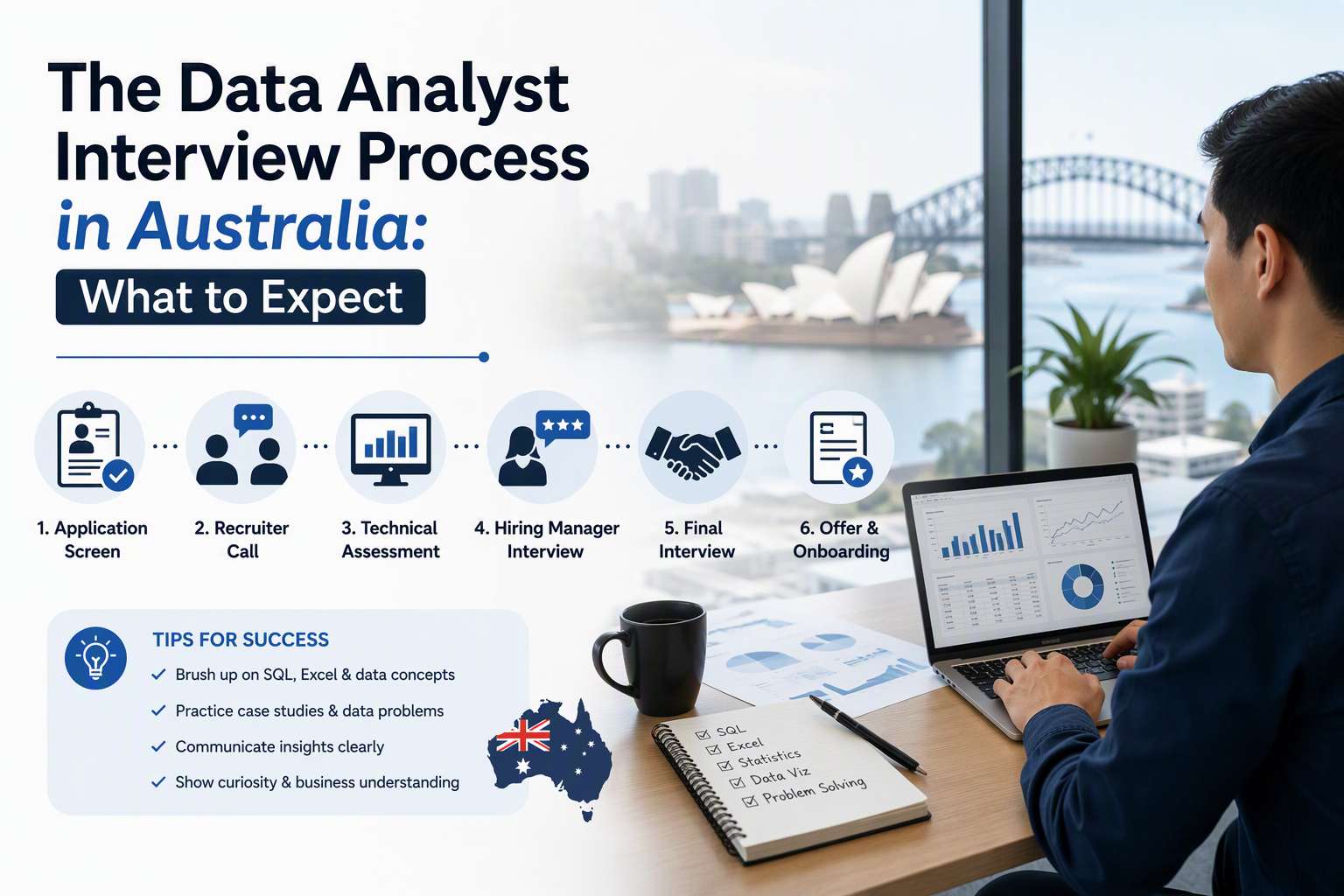
1. Recruiter or HR Screening Call
A 15-30 minute call covering your background, visa/work rights, salary expectations and notice period.
2. Technical Interview
SQL, Excel and BI-tool questions, often delivered live via a shared screen or coding platform such as HackerRank.
3. Case Study or Take-Home Task
A dataset and business question, with 24-72 hours to produce a dashboard, summary or recommendation.
4. Final Panel Interview
A mix of behavioural and stakeholder-management questions with the hiring manager and wider team.
Top Data Analyst Interview Questions & Answers in Australia (2026)
Behavioural Data Analyst Interview Questions
- Why do you want to work as a data analyst in Australia?
Focus on a genuine interest in solving business problems with data, and mention any local industry knowledge relevant to the employer, such as retail, banking or healthcare data trends in Australia.
- Tell me about a time your analysis changed a business decision.
Use the STAR method: describe the Situation, the analytical Task, the Action you took in the tool (Excel, SQL or Power BI) and the measurable Result, such as a cost saving or process improvement.
- How do you handle conflicting priorities from multiple stakeholders?
Explain how you clarify business impact and deadlines with each stakeholder, then communicate a transparent, agreed timeline rather than silently reprioritising work.
- How do you check your own analysis for errors before presenting it?
Mention specific habits: reconciling totals against a source system, sense-checking outliers, and having a peer review complex formulas or queries.
SQL Data Analyst Interview Questions
- What is the difference between INNER JOIN and LEFT JOIN?
An INNER JOIN returns only rows with matches in both tables, while a LEFT JOIN returns all rows from the left table plus matching rows from the right table, with NULLs where no match exists.
- How would you find duplicate records in a table using SQL?
Group by the relevant columns and use HAVING COUNT(*) > 1, or use a window function such as ROW_NUMBER() partitioned by those columns to flag duplicates.
- What is the difference between WHERE and HAVING?
WHERE filters individual rows before aggregation, while HAVING filters groups after a GROUP BY has been applied.
- Write a query to calculate a month-on-month percentage change.
Use a window function like LAG() to pull the previous month’s value into the same row, then calculate (current – previous) / previous * 100 in the SELECT statement.
Excel & Spreadsheet Data Analyst Interview Questions
- What is the difference between VLOOKUP and INDEX-MATCH?
VLOOKUP searches left to right and breaks if columns are inserted, while INDEX-MATCH is more flexible, can look in either direction, and is generally more stable in large workbooks.
- How do you clean a messy dataset in Excel before analysis?
Mention removing duplicates, using TRIM and CLEAN for text formatting, standardising date formats, and validating numeric fields with data validation rules or conditional formatting.
- When would you use a Pivot Table versus a formula-based summary?
Pivot Tables are faster for exploring and reshaping large datasets interactively, while formulas suit repeatable, automated reports that need to update on a fixed template.
Power BI and Tableau Data Analyst Interview Questions
- What is the difference between a calculated column and a measure in Power BI?
A calculated column is computed row by row and stored in the table, while a measure is calculated dynamically at query time based on the current filter context, which makes it more efficient for aggregations.
- How do you handle a slow-loading Power BI dashboard?
Discuss reducing the data model size, using star schema modelling, disabling unnecessary visuals, and pushing transformations upstream into the data source rather than Power Query.
- What is the difference between a live connection and an import in Power BI/Tableau?
Import brings a static snapshot of data into the tool’s own engine for fast performance, while a live connection queries the source system directly, which is slower but always current.
Statistics Data Analyst Interview Questions
- What is the difference between correlation and causation?
Correlation means two variables move together, while causation means one variable directly causes the change in another; a good analyst always checks for confounding variables before claiming causation.
- How do you decide which statistical test to use?
Base the choice on the data type (categorical vs continuous), the number of groups being compared, and whether the data meets assumptions like normal distribution.
- What is a p-value and how do you interpret it?
A p-value indicates the probability of observing the result if the null hypothesis were true; a low p-value (commonly under 0.05) suggests the result is statistically significant.
Case Study and Scenario-Based Questions
- Sales have dropped 15% this quarter across our Melbourne and Perth stores. How would you investigate?
Break the drop down by store, product category and time period; check for seasonality, marketing changes or stock issues; and separate a genuine demand decline from a data or reporting error.
- How would you measure the success of a new feature launch?
Define a clear success metric before launch (such as adoption rate or retention), set up a before/after or A/B comparison, and account for external factors that could skew the result.
Data Analyst Salary Expectations Across Australian Cities (2026)
Salary benchmarks vary meaningfully by city and industry. According to Seek’s salary data and current market listings, indicative annual base salaries for 2026 are:
| City | Entry-Level (0-2 yrs) | Experienced (3+ yrs) |
| Sydney | AU$70 | 000-$85 |
| Melbourne | AU$68 | 000-$82 |
| Brisbane | AU$65 | 000-$78 |
| Perth | AU$65 | 000-$80 |
| Adelaide | AU$62 | 000-$75 |
| Canberra | AU$68 | 000-$85 |
Figures are indicative ranges based on public salary aggregators and current job listings, and will vary by employer, industry and certifications held.
How to Prepare for a Data Analyst Interview in Australia
Alongside practising these data analyst interview questions, a recognised certification helps you stand out in a crowded applicant pool. A structured course also gives you ready-made examples to use in behavioural answers.
- Build SQL and Excel fluency with a Data Analytics certification course designed around real business scenarios.
- Strengthen dashboarding skills with a dedicated Power BI course to answer Power BI-specific interview questions with confidence.
- Round out your data toolkit through Logitrain’s IT and business training programs, which run instructor-led sessions across Sydney, Melbourne, Brisbane, Perth, Adelaide and Canberra.
- Practice explaining a past project out loud using the STAR method before your interview, ideally with a mock interviewer.
Frequently Asked Questions
What questions are asked in a data analyst interview in Australia?
Most Australian employers ask a mix of SQL, Excel, statistics and BI-tool questions alongside behavioural questions about past projects and stakeholder management, as covered in detail above.
Is SQL or Excel more important for data analyst interviews?
Both are typically tested, but SQL is increasingly the deciding factor for mid-level roles, since most Australian employers now store data in cloud warehouses rather than spreadsheets.
What is the average data analyst salary in Australia in 2026?
Entry-level data analysts typically earn between AU$62,000 and AU$85,000 depending on city, while experienced analysts can earn AU$100,000 to AU$120,000 or more; see the city breakdown above.
Do I need a certification to become a data analyst in Australia?
A certification is not always mandatory, but it strengthens your application and gives you structured, current examples to discuss in interviews, particularly if you are changing careers.
Final Thoughts
Walking into an interview with clear, practised answers to these data analyst interview questions puts you ahead of most candidates. If you want structured, job-focused preparation, explore the Data Analytics course at dataanalyticscourses.au or browse the full Logitrain training catalogue for instructor-led options in Sydney, Melbourne, Brisbane, Perth, Adelaide and Canberra.