


If you’ve searched for the data analyst salary in Australia 2026, you’ve probably noticed the numbers are all over the place some sites say $80,000, others say $145,000. Neither is wrong. They’re just measuring different things: junior versus senior roles, base pay versus total compensation, Sydney versus regional cities.
This guide pulls together the most current 2026 figures from SEEK job ads, PayScale surveys, and industry salary reports so you can see exactly where you sit by city, by years of experience, and by the certifications that actually move the needle.
Data Analyst Salary in Australia 2026: The National Picture
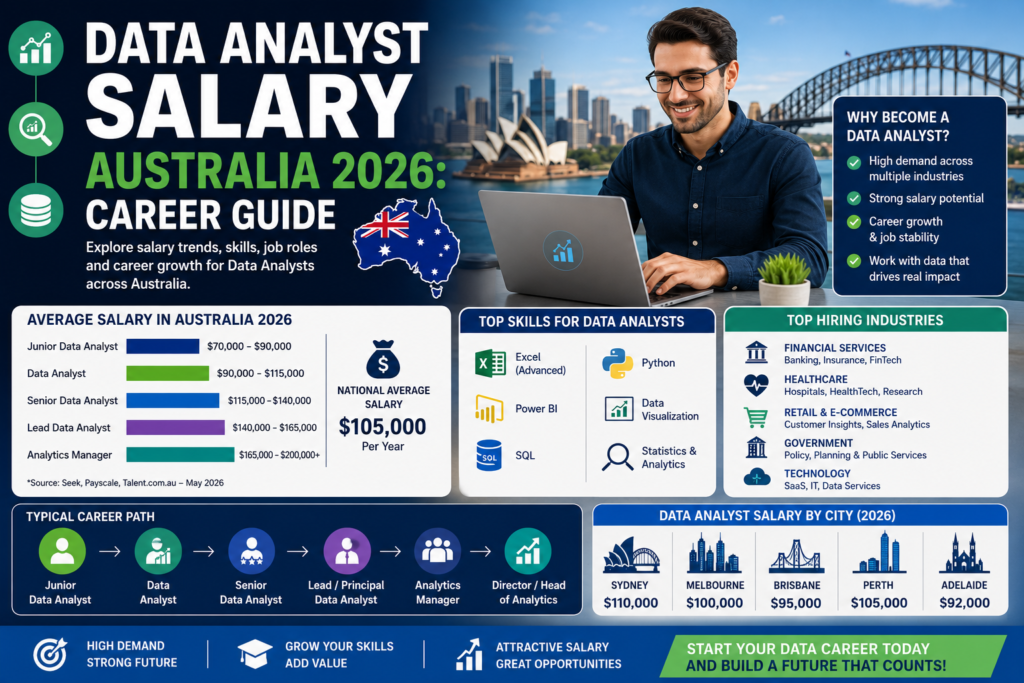
As of 2026, the average data analyst salary in Australia sits between roughly $91,000 and $115,000 a year, depending on the source and how “average” is calculated.
- SEEK (based on advertised job ads): typical range of $95,000–$115,000
- RealPay: national average of $91,438, ranging from $55,250 (entry-level) to $143,000 (senior)
- PayScale: a lower base figure of $81,650, reflecting a wider mix of junior and part-time roles
- ERI: a higher estimate of $145,568, weighted toward large-enterprise and finance-sector roles
The honest takeaway: most working data analysts in Australia earn somewhere in the $85,000–$120,000 band, with the spread driven far more by experience, city, and industry than by the job title itself. A graduate analyst might start around $60,000, while a senior analyst in Sydney finance can clear $150,000 in total compensation.
Data Analyst Salary in Australia by City (2026)
Location remains one of the biggest levers on pay. Financial hubs and mining-linked economies consistently pay more than regional centres.
| City | Average Data Analyst Salary (2026) |
| Sydney | $115,000 – $125,000 |
| Perth | $110,000 – $115,000 |
| Canberra | $100,000 – $106,000 |
| Brisbane | $105,000 – $110,000 |
| Melbourne | $100,000 – $105,000 |
| Hobart | $110,000 – $124,000* |
| Adelaide | $85,000 – $95,000 |
*Hobart’s figure is based on a smaller sample of job ads and can fluctuate more than larger markets.
A few patterns worth noting:
- Sydney consistently pays the most, driven by concentration of Big 4 banks, fintechs, and super funds — but higher rent and transport costs eat into a meaningful chunk of that premium.
- Perth punches above its size thanks to mining and resources companies investing heavily in predictive analytics, though salaries here swing with the commodities cycle.
- Melbourne trails Sydney by roughly 5–10%, but a lower cost of living often means better net take-home value.
- Brisbane and regional NSW analysts working remotely for Sydney- or Melbourne-headquartered companies increasingly capture metro-level pay while living somewhere cheaper — one of the more underrated moves in the current market.
Data Analyst Salary in Australia by Experience Level
Experience is the single strongest predictor of a data analyst’s salary in Australia. Here’s how the typical progression looks in 2026:
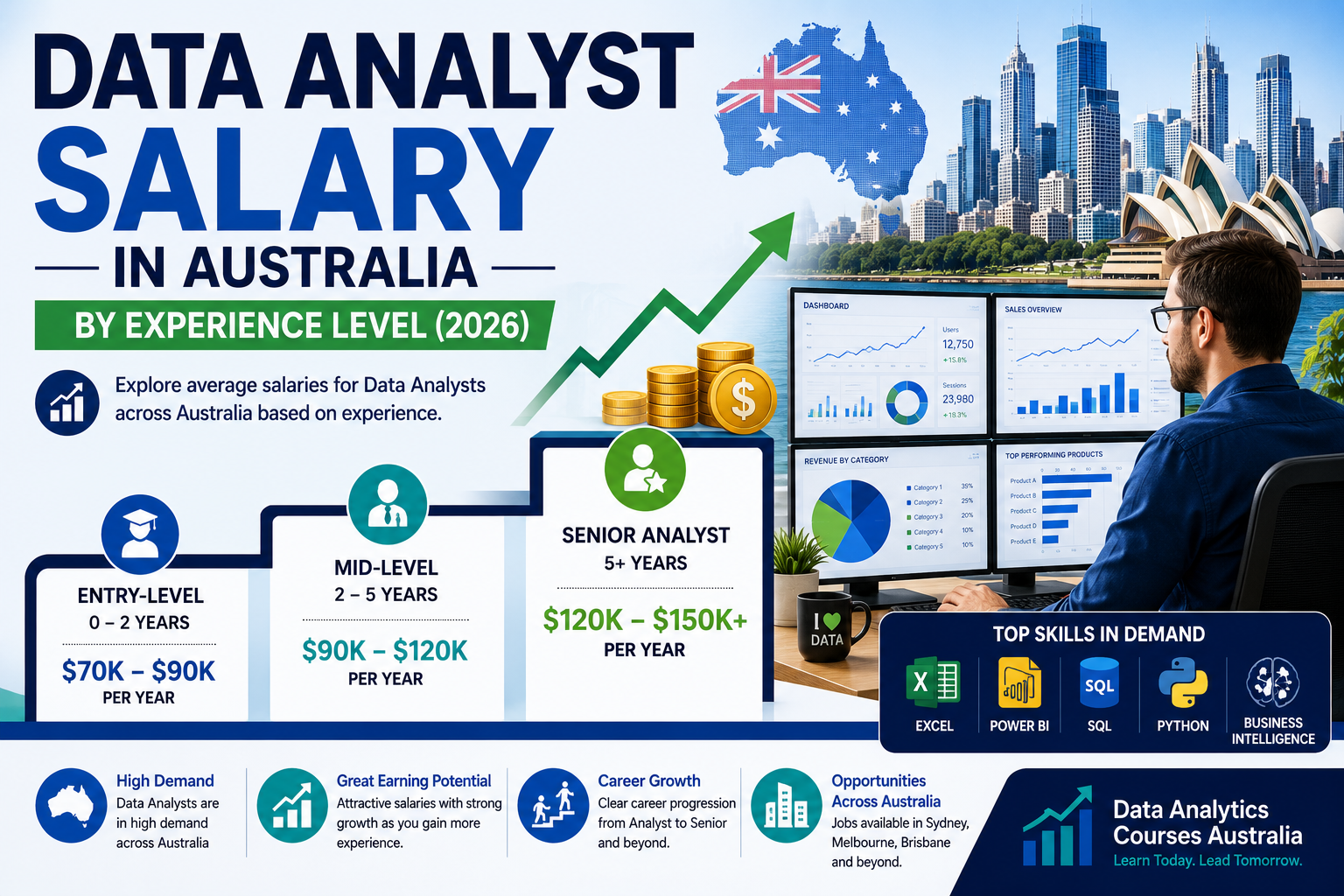
Entry-level (0–2 years): $65,000 – $85,000
Graduates handle data cleaning, standard reporting, and dashboard maintenance. Those with internship experience, a strong portfolio, or SQL/Python skills land toward the top of this range.
Early career (1–4 years): $80,000 – $95,000
Analysts start owning full reporting workflows and begin working directly with stakeholders rather than just producing output.
Mid-level (3–5 years): $95,000 – $115,000
This is where most working analysts sit. Expect ownership of end-to-end projects, more advanced SQL and BI tool use, and the first real negotiating leverage.
Senior (5–10+ years): $120,000 – $150,000+
Senior data analysts in finance, consulting, or AI-driven tech firms can see total compensation including bonuses reach $155,000–$170,000. Contractors at this level often command day rates of $750–$1,050.
Beyond ten years, many analysts either move into leadership (analytics manager, head of insights) or pivot toward data science, a transition that typically takes five to seven years and can unlock a further 20–30% pay jump.
How Certifications Affect Data Analyst Salary in Australia
Certifications won’t automatically double your pay, but in 2026 they’re doing more work than ever especially for candidates without a traditional degree. Australian employers are increasingly shortlisting candidates based on demonstrated tool proficiency over formal qualifications, particularly for entry-level and mid-level seats.
Here’s how the major certifications stack up:
- Google Data Analytics Professional Certificate — the most recognised entry point. It won’t guarantee a six-figure salary on its own, but it’s a credible signal for graduates with no formal data background and often clears the resume-screening stage that experience alone can’t.
- Microsoft Power BI / Azure Data certifications — carry real hiring weight. Employers frequently list these as a substitute for a degree, and Power BI specialists building executive-ready dashboards can add $10,000–$15,000 to their earning potential.
- Tableau Desktop Specialist / Certified Data Analyst — valuable for visualisation-heavy, stakeholder-facing roles, particularly in consulting and finance.
- Cloud platform certifications (AWS, Azure, GCP) — analysts comfortable in Databricks, Snowflake, or BigQuery can command roughly a 10–20% premium, as cloud-native skills reduce dependence on dedicated data engineering support.
- Advanced SQL — not technically a certification most of the time, but arguably the single most non-negotiable skill. It’s near-essential for anything above a junior title.
- Python (pandas, NumPy, scikit-learn) — still the strongest all-round technical skill, adding an estimated $10,000–$20,000 to average pay.
The bigger shift for 2026: certifications in AI/LLM tooling (using Copilot, Claude, or GPT-based workflows to scale analysis) and data governance/privacy (Australian Privacy Act compliance) are emerging as genuine salary differentiators, not just nice-to-haves.
Highest-Paying Industries for Data Analysts in Australia
Not all industries pay the same for identical skill sets sometimes by $30,000–$40,000 at the same career stage.
| Industry | Typical Salary Range |
| Finance, Banking & Fintech | $115,000 – $160,000 |
| Technology & Consulting | $75,000 – $110,000 (plus equity at many firms) |
| Government & Public Sector | $70,000 – $95,000 |
| Healthcare & Pharmaceuticals | $65,000 – $100,000 |
Finance and fintech dominate the top end, driven by the Big 4 banks and a growing fintech sector willing to pay for analysts who can translate data into risk and revenue decisions. Government roles pay less but offer stability and better work-life balance a trade-off many analysts happily make.
Skills That Push Your Data Analyst Salary Higher in 2026
Technical ability gets you shortlisted; business fluency gets you the premium. The analysts seeing the fastest pay growth in 2026 combine:
- Core technical skills — SQL, Python, Excel, and at least one BI tool (Power BI or Tableau)
- Business translation ability — turning a data finding into a concrete recommendation stakeholders act on
- Stakeholder communication — presenting insights to non-technical audiences clearly and confidently
- AI-assisted workflows — using modern AI tools to speed up analysis without losing rigour
- Data governance awareness — understanding privacy and compliance obligations, which are becoming a genuine hiring filter
Frequently Asked Questions
What is the average data analyst salary in Australia in 2026?
Most sources place the national average between $91,000 and $115,000, depending on experience mix and data source.
Which city pays data analysts the most in Australia?
Sydney consistently leads, followed closely by Perth, with Brisbane and Melbourne close behind.
Do certifications really increase a data analyst’s salary?
Yes, particularly Power BI, Azure, and cloud platform certifications, which employers increasingly treat as a credible alternative to a formal degree.
How much do senior data analysts earn in Australia?
Senior data analysts typically earn $120,000–$150,000 base, with total compensation reaching $155,000–$170,000 in finance or tech.
Final Thoughts
The data analyst salary in Australia 2026 landscape rewards a specific combination: the right city (or a remote arrangement that captures city-level pay), a few years of hands-on experience, and at least one certification that proves you can use the tools employers actually run SQL, Power BI, Python, or a cloud platform. None of these alone will double your income, but stacked together, they’re the difference between the $65,000 graduate offer and the $150,000 senior package.