


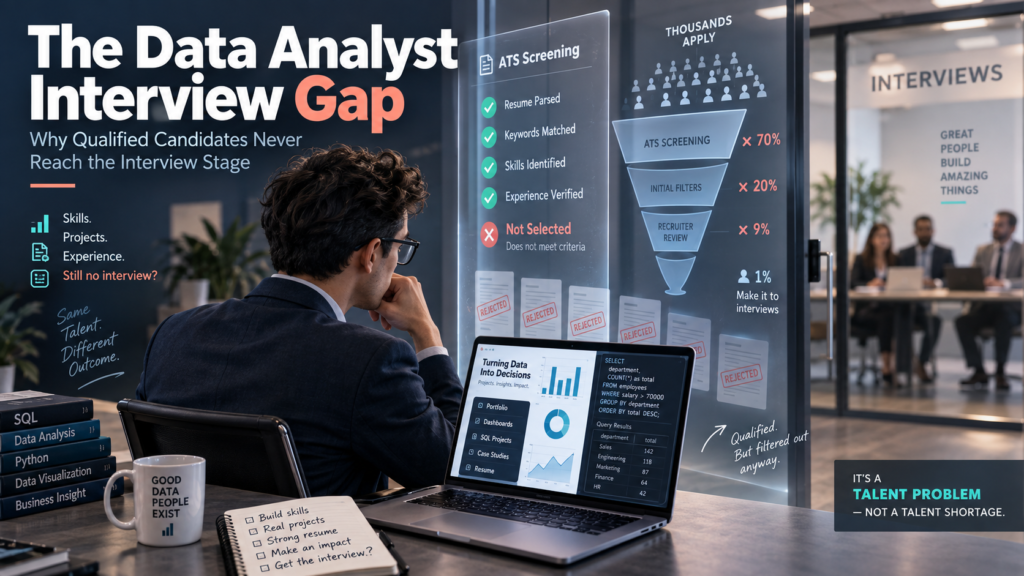
The data analyst interview gap is the invisible wall that stops well-qualified candidates from ever hearing back not because they lack skill, but because their resume never signals the right skill in the first place. Across Sydney, Melbourne, Brisbane, Perth, Adelaide and Canberra, hiring managers report the same pattern: a flood of applications for every data analyst role, but only a handful of candidates worth interviewing. If you have applied to dozens of jobs and heard nothing back, you are almost certainly on the wrong side of this gap and it has very little to do with how good you actually are with data.
What Is the Data Analyst Interview Gap?
The data analyst interview gap describes the mismatch between what candidates believe makes them employable and what recruiters and applicant tracking systems (ATS) actually screen for. Most candidates assume a completed course, a certificate, or a university degree is enough to get noticed. In reality, recruiters in Australia’s competitive analytics market spend an average of six to eight seconds scanning a resume before deciding whether it moves forward. In that window, generic phrases like “proficient in Excel” or “completed a data analytics course” simply do not register.
This interview gap widens further because most entry-level candidates apply with tutorial-style projects clean, pre-formatted datasets with obvious answers that do not resemble the messy, real-world data employers actually work with. Recruiters can tell the difference immediately, and it is one of the fastest ways an application gets filtered out before a human ever reads it.
Why the Interview Gap Exists in the Australian Job Market
1. Resumes List Tools, Not Outcomes
A resume that says “used Power BI and SQL” tells a hiring manager nothing about impact. What closes the data analyst interview gap is outcome-based language: “Built a Power BI dashboard that reduced reporting time by 40%” or “Wrote SQL queries that identified $120,000 in recoverable revenue.” Employers in Sydney and Melbourne consistently shortlist candidates who quantify results, not tools.
2. No Evidence of Real Business Context
Certificates prove you sat through a course. They do not prove you can walk into a business, understand its data, and produce something a stakeholder will actually use. This is the single biggest driver of the interview gap for data analysts a portfolio built entirely on tutorial datasets, with no messy, multi-source, real-world project to show.
3. Keyword Mismatch With ATS Systems
Large employers across Brisbane, Perth and Adelaide run every application through an ATS before a recruiter sees it. If your resume does not mirror the exact phrasing in the job ad SQL, Power BI, data visualisation, stakeholder reporting, data cleaning the system filters you out automatically, regardless of your actual ability. This is a mechanical, not a merit-based, cause of the interview gap, and it is entirely fixable.
4. No Recognised Certification to Anchor the Resume
Recruiters use certifications as a fast filter when comparing hundreds of applicants. A resume with PL-300, SQL for Data Analysis, or an Azure Data Fundamentals badge signals a verified skill level in seconds closing part of the interview gap before the interview is even requested.
How to Close the Data Analyst Interview Gap
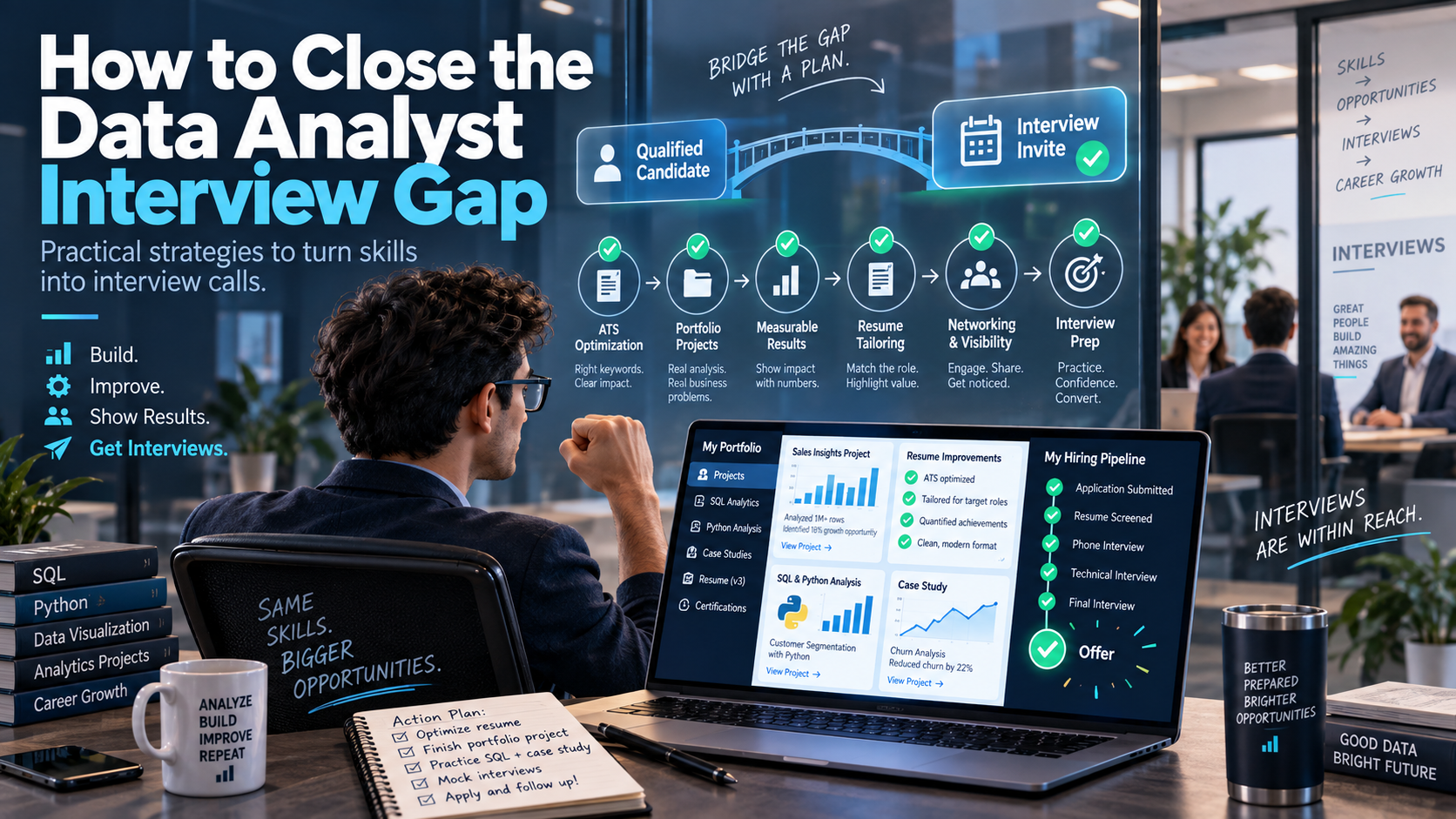
| What Keeps Candidates on the Wrong Side of the Gap | What Actually Closes the Interview Gap |
| Generic “skills used” resume bullets | Outcome-based bullets with numbers and business impact |
| Only tutorial or textbook datasets in the portfolio | One real, messy, multi-source project with a written case study |
| No certification, or an unrecognised one | A recognised credential such as PL-300 or Azure Data Fundamentals |
| Resume wording that doesn’t match the job ad | Resume rewritten per application to mirror ATS keywords |
| Power BI only, no SQL or data-modelling depth | Combined tool stack: SQL + Power BI + data storytelling |
City-by-City: Where the Interview Gap Hits Hardest
The data analyst interview gap is not evenly distributed across Australia. In Sydney and Melbourne, where analytics roles attract the highest volume of applicants, ATS filtering is the dominant cause resumes are rejected before a human ever opens them. In Brisbane and Perth, employers weigh industry-specific data exposure (mining, logistics, healthcare) more heavily, so candidates without a sector-relevant project see the widest gap. In Adelaide and Canberra, government and public-sector employers place unusual weight on recognised certification, meaning candidates without a formal credential are filtered out earliest, regardless of portfolio quality.
Certifications That Help Close the Data Analyst Interview Gap
Employers consistently shortlist candidates faster when a resume includes a certification they recognise. Three credentials do the heaviest lifting for Australian data analyst applicants:
- SQL for Data Analysis proves query-writing ability recruiters can verify instantly.
- Power BI (PL-300) the most requested visualisation skill in Australian job ads.
- Azure Data Fundamentals signals cloud-data literacy, increasingly expected even in entry-level roles.
Build all three around a structured, job-focused pathway with the Data Analytics Courses program, which is designed specifically to close this interview gap for career-changers and graduates.
For candidates who already know Power BI but want to go deeper into modelling and DAX, the Power BI Course builds the dashboard depth that recruiters ask about at interview stage.
If the target roles lean toward cloud analytics, the Azure Certifications pathway adds the Azure Data Fundamentals credential that closes the certification gap in government and enterprise hiring.
All programs sit under Logitrain, Australia’s long-established IT training provider, with instructor-led delivery across every major city.
What Australian Salary Data Confirms About the Interview Gap
Labour-market data consistently shows a wide gap between the number of data analyst applicants and the number who reach interview a trend explored in detail by Seek’s Data Analyst career guide, which tracks demand, salary bands and required skills across Australian cities.
This confirms what recruiters already know anecdotally: the interview gap is a resume and positioning problem far more often than a skills problem. Candidates who fix the resume, add a real project, and hold a recognised certification move through screening noticeably faster.
Closing Thoughts on the Data Analyst Interview Gap
The data analyst interview gap is real, but it is not permanent. It closes the moment a resume speaks the language of outcomes instead of tools, a portfolio includes one genuinely messy real-world project, and a recognised certification anchors the application before an ATS or recruiter ever has a chance to filter it out. Candidates in Sydney, Melbourne, Brisbane, Perth, Adelaide and Canberra who make these three changes consistently report faster callbacks because they have stopped applying from the wrong side of the interview gap.