
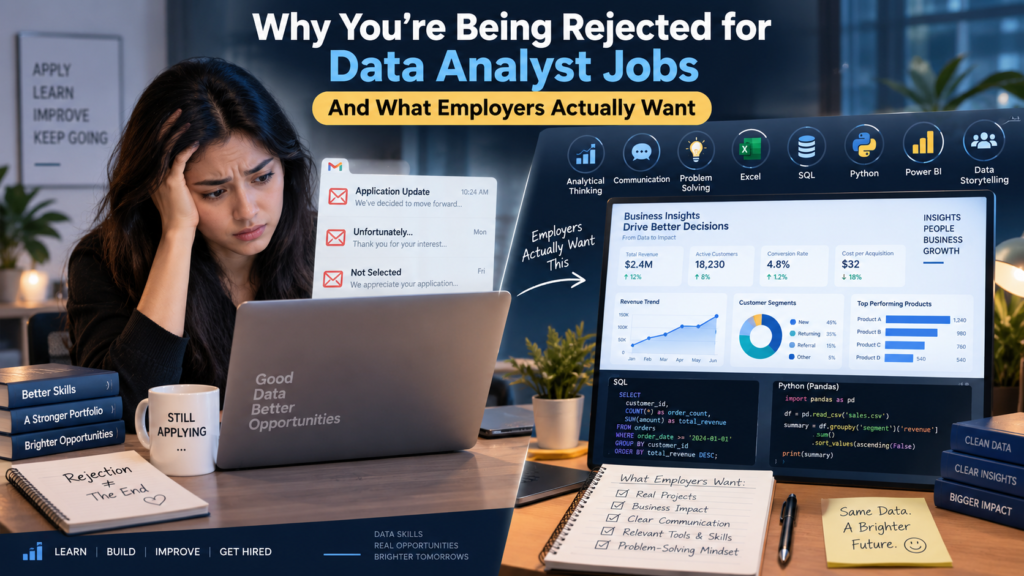
Being rejected for data analyst jobs is frustrating enough on its own. What makes it worse is the silence. You spend an evening tailoring your resume, you hit submit, and a week later you get a two-line email saying the company has decided to move forward with other candidates. No reason. No feedback. Just a nagging feeling that you’re missing something obvious.
You probably are, but it’s rarely what you think. When people get rejected for data analyst jobs, they blame the market, their experience or the number of applicants. Those things matter, but the same handful of gaps show up again and again, and almost all of them can be fixed in weeks, not years.
This guide covers the real reasons you’re being rejected for data analyst jobs, what Australian employers want, and a 30-day plan to turn rejections into interviews.
The 7 Most Common Reasons You’re Rejected for Data Analyst Jobs
Hiring managers don’t publish their scorecards, but the patterns are consistent. Here are the seven reasons candidates get rejected for data analyst jobs most often:
- Your resume lists tools instead of business results.
- Your portfolio uses the same tutorial datasets as everyone else.
- Your SQL is shallower than your Power BI dashboards suggest.
- You can build a chart but can’t explain the decision behind it.
- Your resume doesn’t survive applicant tracking systems or the quick human screen.
- Your interview answers describe tasks instead of thinking.
- You’re applying for roles that don’t match your current level.
Reason 1: Your Resume Lists Tools Instead of Outcomes
Open any stack of data analyst applications and you’ll see the same skills line: Excel, SQL, Power BI, Python, Tableau. It tells a hiring manager almost nothing, because a list can’t show whether you used those tools to answer a real question or just to finish a course exercise. What gets a data analyst resume shortlisted is evidence of impact. Compare these two bullet points:
- Weak: Created dashboards in Power BI for sales data.
- Stronger: Built a Power BI sales dashboard with six DAX measures that replaced a manual weekly Excel report and gave regional managers one place to track targets.
The second version names the tool, the technique, the problem and the audience, and it doesn’t need invented numbers. If you’re changing careers, use your projects and past jobs honestly. Keep the resume to two pages, open with a summary that names your target role, and mirror the job ad’s wording wherever it’s true.
Reason 2: Your Portfolio Uses the Same Datasets as Everyone Else
Titanic survivors. Superstore sales. Iris flowers. These datasets are great for learning and terrible for standing out. Hiring managers have seen them so often that the projects blur together, and clean tutorial data hides the hardest part of the job: data that’s incomplete, inconsistent and occasionally just wrong. If you’ve been rejected for data analyst jobs after a promising first call, a thin portfolio is a common culprit.
A data analyst portfolio that earns interviews shows the whole workflow: a real question, messy data, your cleaning decisions, the analysis and a recommendation someone could act on. The Australian Bureau of Statistics and data.gov.au both publish datasets you can use for local, relatable projects. A few ideas:
- Compare housing affordability indicators across Sydney, Melbourne, Brisbane, Perth, Adelaide and Canberra.
- Analyse public transport punctuality or road safety data for one state and recommend where to focus.
Publish the work where a recruiter can open it in one click, such as a public Power BI report or a GitHub repository, with a plain-English summary on top. Three well-explained projects beat ten shallow ones.
Reason 3: Your SQL Is Weaker Than Your Dashboards Suggest
Many candidates learn Power BI first because it’s visual and satisfying. Then a technical screen asks them to write a query from scratch, and that’s where a lot of applications end.
SQL is still one of the most common technical tests in analyst hiring. Employers want to see that you can join tables correctly, aggregate without duplicating rows, handle NULL values, and use window functions when the question gets harder. A typical test might ask for the top three customers by revenue in each state. If you can’t write that from memory, a timed test will expose it.
The fix is unglamorous practice: write queries daily on messy, multi-table data and explain each one out loud. If you’d rather learn with an instructor, our SQL for Data Analysis – Beginner course covers querying, filtering, joining and analysing workplace data.
Reason 4: You Can Build Charts but Can’t Explain the Decision
A dashboard isn’t the deliverable. The decision it supports is. Candidates who get rejected for data analyst jobs after interviews often describe what they built in detail and say very little about why it mattered or what changed afterwards.
Employers want analysts who ask about the business question first. Who will read this, and what will they do differently on Monday? Compare “Sales fell in Queensland in March” with “March sales fell in Queensland because two high-volume stores ran out of their top product, so a reorder rule would fix it fastest.” The second sentence is an insight. The first is a chart caption.
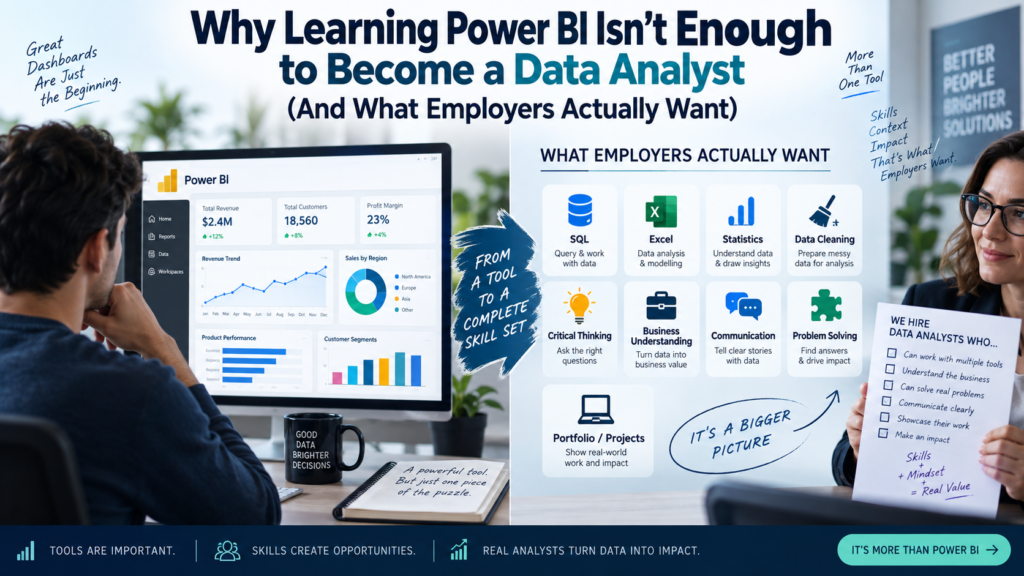
Finish every project with three lines: what I found, why it matters, and what I’d recommend. We cover this gap further in our post on why Power BI alone isn’t enough to become a data analyst.
Reason 5: Your Resume Doesn’t Survive the ATS or the Quick Screen
Many employers and recruiters use applicant tracking systems (ATS) to sort applications before a person reads them closely. Templates with columns, icons and skill bars can confuse those systems, and plenty of people rejected for data analyst jobs never realise the format was the problem.
Keep the layout simple, use standard headings such as Experience, Education and Skills, and write tool names in full at least once, for example Microsoft Power BI and Structured Query Language (SQL). The human reader may give you only seconds, so the top third of page one should show your target title, core stack and strongest result.
Reason 6: Your Interview Answers Describe Tasks, Not Thinking
“I cleaned the data and built a dashboard” is a task. “The sales file had duplicate customer IDs, so I checked with finance which record was correct, removed the rest and documented the rule” is thinking. Interviewers hire the second version.
Use the STAR structure (situation, task, action, result) with a data flavour: what was the question, what was wrong with the data, what approach did you pick and why, and what happened next. Prepare stories for questions like these:
- Tell me about a time the data was messy or wrong.
- How would you handle two stakeholders who want different numbers for the same metric?
- Walk me through a dashboard you built and the decision it changed.
For more practice, see our guide to data analyst interview questions and answers for Australia.
Reason 7: You’re Applying for Roles That Don’t Match Your Level
“Data analyst” covers everything from Excel reporting to roles that expect Python, cloud platforms and data modelling. Some entry-level data analyst jobs in Australia ask for experience a new applicant couldn’t have, and applying to all of them is a fast way to get rejected for data analyst jobs in bulk.
Read the tools and responsibilities, not just the title. Junior data analyst, reporting analyst, insights analyst and business intelligence analyst roles are often better first targets than senior or engineering-flavoured positions. And don’t discard your previous career. Experience in finance, healthcare, retail, logistics or government is a real advantage over purely technical applicants, so say so clearly.
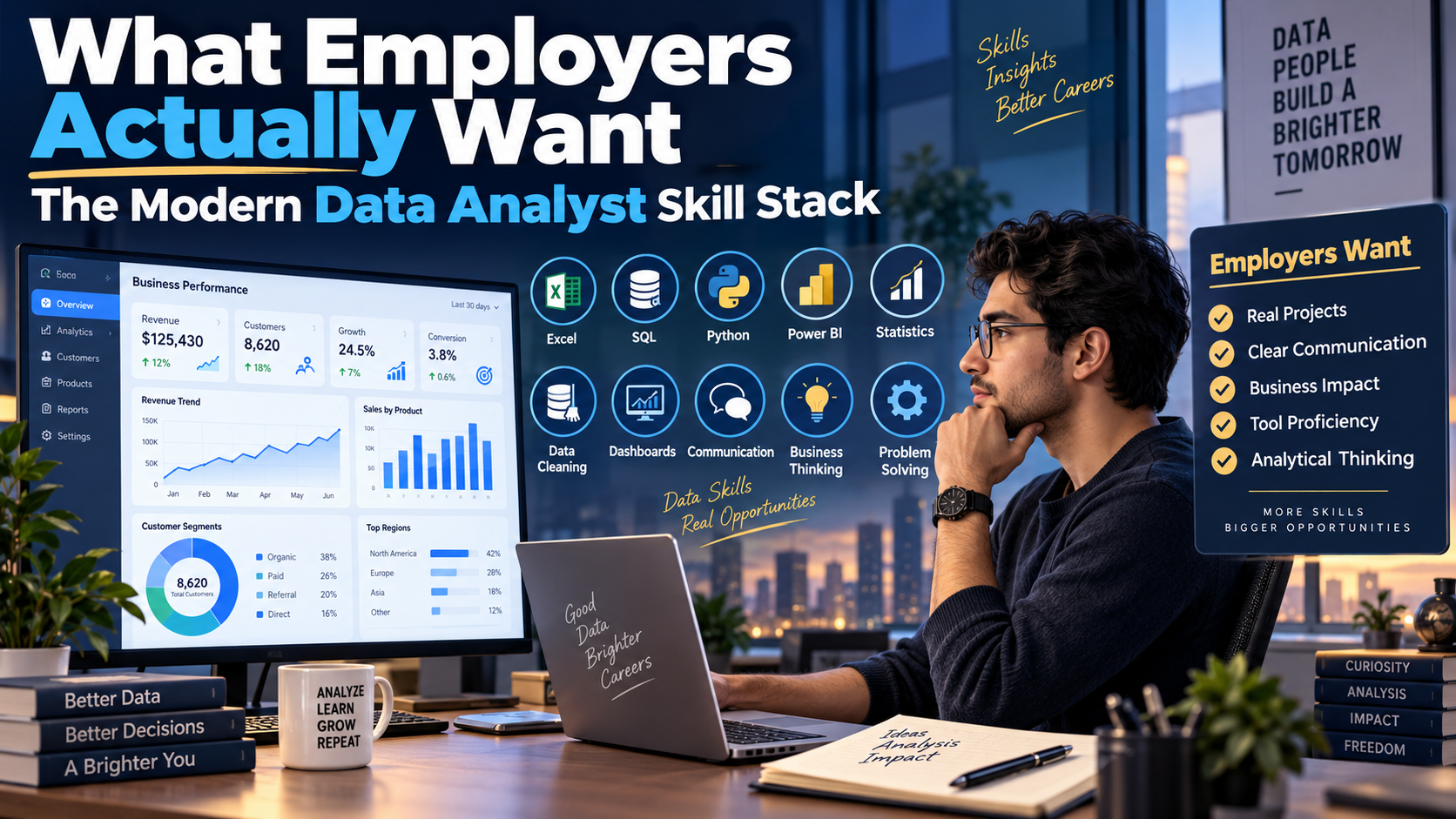
What Employers Actually Want: The Modern Data Analyst Skill Stack
Strip away the buzzwords and employers want someone who can get data, trust it, analyse it and explain it. This table shows the gap between what many candidates rejected for data analyst jobs present and what hiring managers hope to see.
| What rejected candidates often show | What employers want to see |
| Tutorial datasets such as Titanic or Superstore | Real, messy data with the cleaning steps documented |
| “Proficient in Power BI” on the skills line | A live report with a data model, DAX measures and a clear business question |
| Basic SELECT queries | Joins, aggregations, window functions and sensible query habits |
| Certificates listed without context | Certifications backed by a project that uses the same skills |
| Resume bullets that name tools | Resume bullets that show a measurable result |
| Charts with no commentary | Insights, recommendations and next steps |
| One generic resume for every job | A role-specific summary tied to the employer’s industry |
SQL and Data Preparation
This is the foundation. Pair querying skills with Excel for cleaning and quick analysis, and start with SQL for Data Analysis – Beginner if databases are new to you.
Power BI and Data Modelling
Building a chart is the easy part. Employers look for clean data models, sensible DAX measures and reports people can actually use. Our Power BI Fundamentals course covers reports and dashboards, and Advanced Power BI Modelling goes deeper into modelling. You can also explore the dedicated Power BI course website.
Cloud Data Basics
More Australian teams work with data in the cloud, so it helps to understand relational and non-relational data on Microsoft Azure. Azure Data Fundamentals is a sensible starting point, Azure Certifications covers the wider pathway, and the Microsoft DP-605 course focuses on Microsoft Fabric analytics.
Python, Communication and Business Context
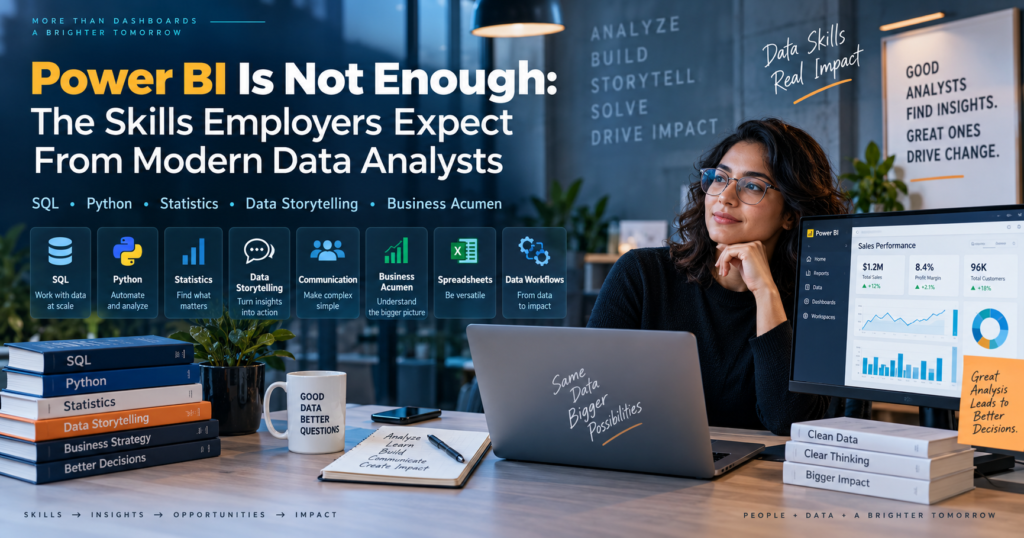
Python with Pandas helps with bigger datasets, but for most junior roles it’s a bonus rather than a gate. Communication isn’t. For more, read our article on the skills employers expect from modern data analysts.
Do Certifications Help When You’re Rejected for Data Analyst Jobs?
Yes, with a catch. A certification proves you’ve met a recognised standard, not that you can solve a business problem. Employers respond best to a certificate backed by a project using the same skills.
The Microsoft Power BI Data Analyst Associate (PL-300) is a good example. Microsoft Learn outlines the skills measured as preparing, modelling, visualising and analysing data, and deploying and maintaining assets, which mirrors the daily work of many analysts. Our PL-300 course prepares you for it. Starting from scratch? CompTIA Data+ is a vendor-neutral entry point, and the BCS Professional Certificate in Data Analysis offers a formal grounding in analysis and modelling.
Data Analyst Jobs Across Australia: What Changes by City
The core skills are the same everywhere, but the industries hiring are not. Jobs and Skills Australia publishes occupation and industry profiles if you want the wider labour market picture. Here’s what to keep in mind by city:
- Sydney: finance, technology and government hire heavily. See data analytics courses in Sydney.
- Melbourne: finance, healthcare, retail and state government all hire analysts. See data analytics courses in Melbourne.
- Brisbane: a growing tech and resources sector values analytics skills. See data analytics courses in Brisbane.
- Perth: mining, energy and resources rely on data-driven decisions. See data analytics courses in Perth.
- Adelaide: public sector, health and education employers need reporting skills. See data analytics courses in Adelaide.
- Canberra: federal departments and agencies employ many analysts. See data analytics courses in Canberra.
Not in a capital city? Live online classes offer the same instructors and labs from anywhere. See our locations page.
How to Read a Data Analyst Rejection Email
Most rejection emails are templates, but when you’re rejected for data analyst jobs the stage still tells you something. Use this as a rough guide:
| Where it happened | What it often means | What to do next |
| No reply after applying | Your resume didn’t match the ad closely or was missed by the ATS | Rewrite bullets around outcomes and the ad’s keywords |
| After the technical test | SQL, Excel or Power BI gaps under time pressure | Do timed practice and review every question you missed |
| After the final interview | Gaps in communication or business context | Rehearse STAR stories and politely ask for feedback |
Your 30-Day Plan to Stop Being Rejected for Data Analyst Jobs
You don’t need a career overhaul, just focused work. Here’s a realistic month:
- Week 1: Fix your resume and LinkedIn. Rewrite every bullet with an action, a result and an audience, simplify the layout for ATS and add a two-line summary that names your target role.
- Week 2: Sharpen SQL and choose a real dataset. Practise queries daily and pick an Australian open dataset for a project that answers one clear question.
- Week 3: Build and publish. Create the dashboard, write up your findings and recommendations, and publish it where a recruiter can open it in one click.
- Week 4: Rehearse and apply with focus. Practise STAR answers out loud, then send 10 to 15 well-matched applications instead of 100 generic ones.
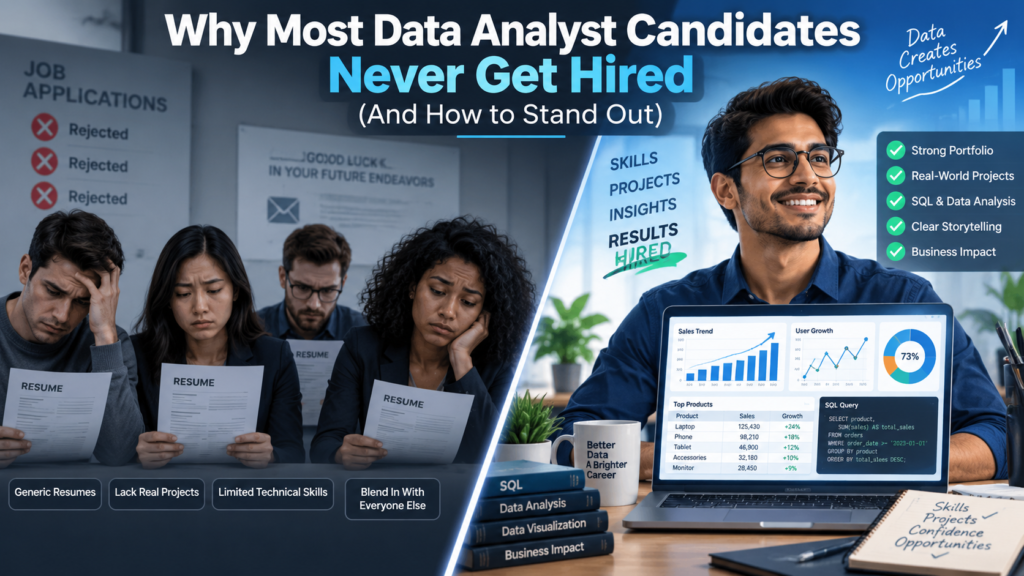
If you’d like structure, feedback and a recognised certification along the way, browse all our data analytics courses or read our earlier post on why most data analyst candidates never get hired.
Frequently Asked Questions
Why am I not getting any interviews for data analyst jobs?
Most often it’s the resume. Check whether your bullets show outcomes, whether the layout works with ATS software and whether you’re applying for roles that suit your level. Reasons 1, 5 and 7 above cover the fixes.
Why am I rejected for data analyst jobs even though I have a certificate?
A certificate shows you’ve studied the material, but employers hire for proof that you can apply it. Check whether your resume shows results, whether your portfolio uses real data and whether your SQL holds up in a timed test.
Is Power BI enough to get a data analyst job in Australia?
Usually not on its own. Most employers also expect SQL, Excel, data cleaning and clear communication, and cloud basics such as Azure help too.
Can I become a data analyst without a degree?
It depends on the employer. Some, particularly large corporates and government agencies, list a degree as a requirement, while others weigh skills, certifications and portfolio evidence more heavily. Check each ad carefully and use your projects to close the gaps.
Turn Rejection Into Your Next Interview
Being rejected for data analyst jobs doesn’t mean you’re not cut out for the field. It usually means your evidence hasn’t caught up with your ability. Fix the resume, build a real portfolio, strengthen your SQL, learn to explain your decisions and target the right roles, and the responses start to change.
If you want a clear pathway, speak to a course advisor at Data Analytics Courses Australia on 1300 649 299 or send us an enquiry. You can also explore Logitrain, our data analytics blog or the FAQs.