
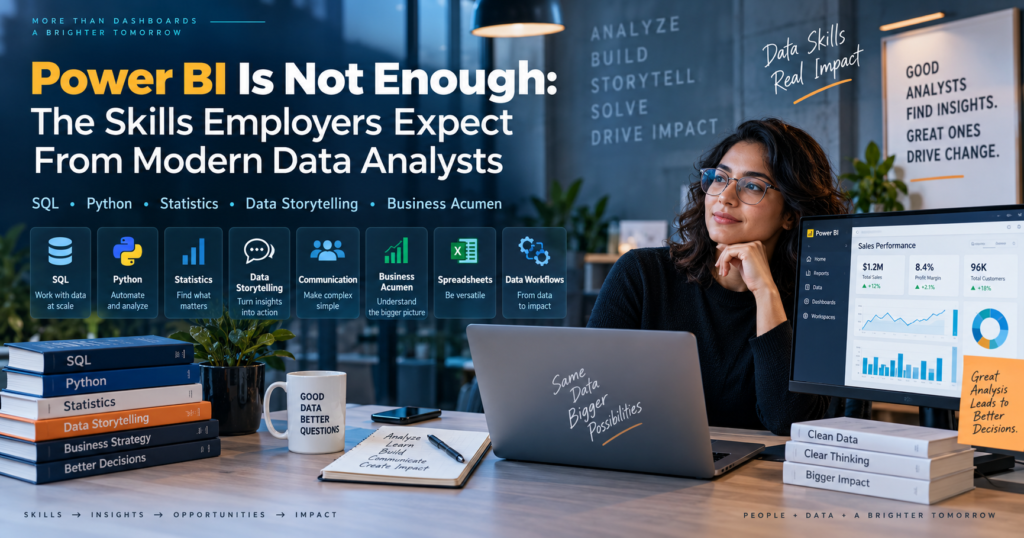
Power BI dashboards used to be enough to land a data analyst role. In 2026, they aren’t. The skills employers expect from data analysts now go well beyond dragging fields onto a report canvas. Power BI is still essential, but hiring managers are increasingly filtering out candidates who can build a pretty dashboard but can’t write a SQL query, explain a statistical result, or tell a business story with the numbers.
If you’re relying on Power BI alone to carry your resume, this guide breaks down exactly what else employers now expect, and how to build that skill stack without starting from zero.
Why Power BI Alone Isn’t Enough Anymore
Power BI is one of the most widely taught business intelligence tools in Australia, which means it’s also one of the most common lines on every data analyst resume. As the entry barrier has dropped, Power BI proficiency has shifted from a differentiator to a baseline expectation. Employers now assume you can build a report; what they’re screening for is whether you can source clean data, validate it, model it correctly, and explain what it means to a non-technical stakeholder.
The Skills Employers Expect From Data Analysts Beyond Power BI
These are the capabilities that consistently separate shortlisted candidates from the rest of the applicant pool.
1. SQL — Non-Negotiable
SQL is the single most requested skill in Australian data analyst job ads, ahead of any specific BI tool. Employers expect you to pull, join, and clean data directly from a database rather than relying on someone else to hand you a clean extract.
2. Data Modelling and DAX Depth
Knowing how to drag a visual into Power BI is different from understanding star schemas, relationships, and writing efficient DAX measures. Employers expect analysts to build a data model correctly, not just consume one someone else built.
3. Statistics Fundamentals
You don’t need a statistics degree, but you do need to understand distributions, correlation versus causation, confidence, and how to avoid drawing misleading conclusions from a dashboard. This is what separates “reporting” from “analysis.”
4. Python or R for Advanced Analysis
Not every analyst role requires scripting, but the roles that pay more consistently do. Python (particularly pandas) is increasingly expected for tasks Power BI can’t handle cleanly: advanced data cleaning, forecasting, and repeatable automation.
5. Business Storytelling and Stakeholder Communication
The most consistently cited gap employers report is the ability to translate a finding into a business recommendation. A dashboard full of correct numbers that nobody acts on has no value. Employers expect analysts to present findings clearly, tailored to the audience in the room.
6. Data Governance and Quality Awareness
Understanding data lineage, privacy obligations, and why “garbage in, garbage out” matters is now a standard expectation, particularly in regulated Australian industries like finance, health, and government.
7. Cloud and Azure Data Fundamentals
As more Australian organisations move their data estate to the cloud, familiarity with Azure data services (or equivalent cloud platforms) is increasingly expected even in analyst-level roles, not just for data engineers.
Power BI Skills vs the Full Modern Data Analyst Skill Set
Here’s how the baseline Power BI skill set compares to what employers are actually screening for in 2026.
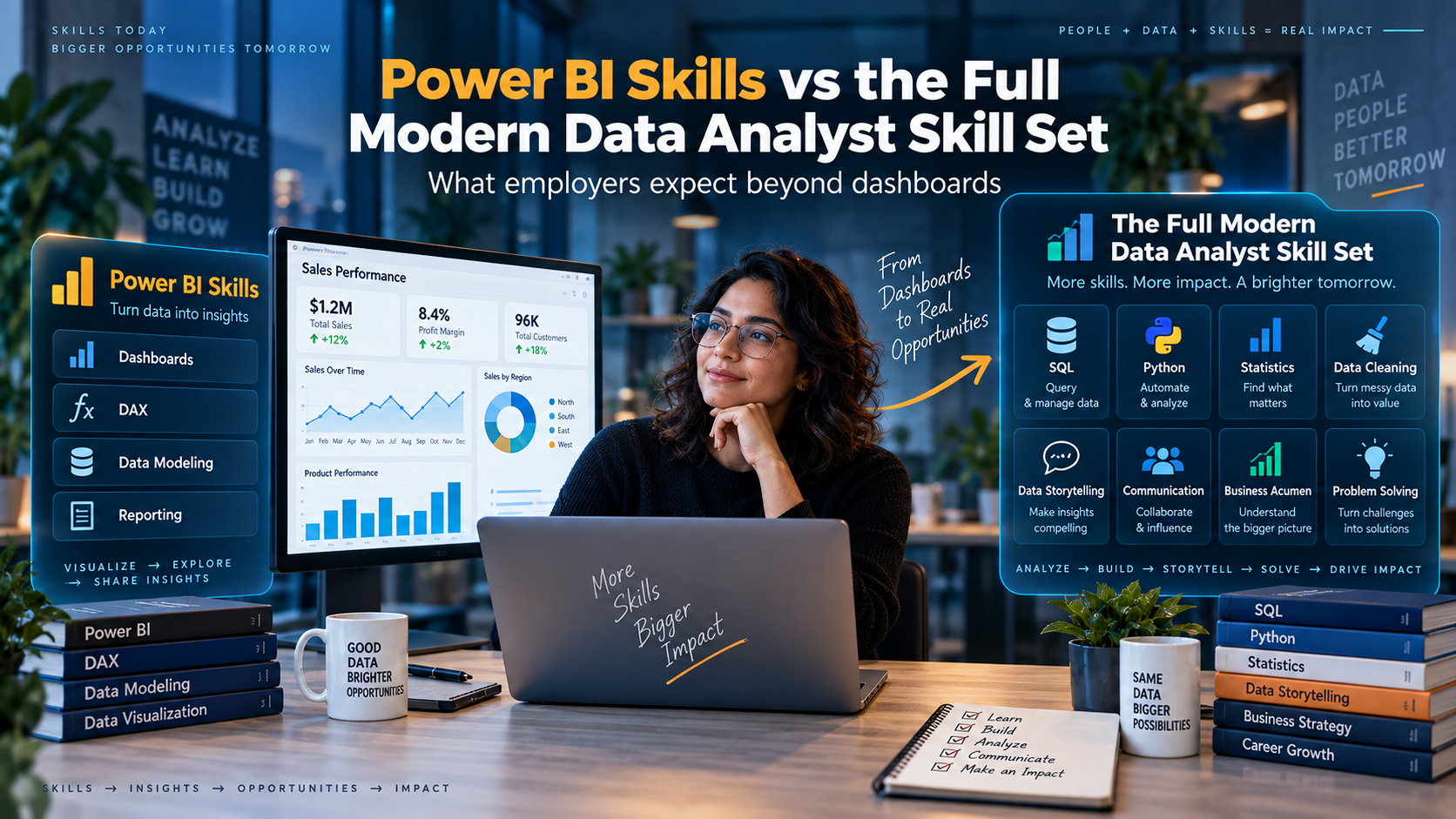
| Power BI-Only Skill Set | What Employers Expect Now |
| Building reports and dashboards | Sourcing, cleaning, and modelling the data before it reaches a dashboard |
| Basic DAX measures | Efficient, well-structured DAX and a correctly designed data model |
| Reading visuals | Applying statistical reasoning to validate what the visual is showing |
| Power Query basics | SQL fluency for querying data directly from source systems |
| Presenting a finished dashboard | Framing findings as a business recommendation for stakeholders |
| Working within one BI tool | Baseline familiarity with cloud data platforms like Azure |
How to Build These Skills Without Starting From Zero
- Audit your current skill set honestly. List what you can already do in Power BI, then map it against the skill stack above to find the real gaps.
- Prioritise SQL first. It has the highest return on effort, because it’s requested in nearly every data analyst job ad regardless of which BI tool the employer uses.
- Practise on real, messy datasets. Clean, competition-style datasets don’t build the judgement employers are testing for. Practise on public Australian government or industry datasets instead.
- Get certified to validate the gaps you’ve closed. A recognised certification signals to employers that a specific skill gap has been closed, not just self-studied informally.
- Practise explaining findings out loud. Record yourself walking through a dashboard as if presenting to a non-technical manager. This is the single most under-practised skill among candidates.
Certifications That Round Out a Power BI-Heavy Resume
- Microsoft PL-300 (Power BI Data Analyst) validates advanced Power BI, DAX, and data modelling skills.
- Microsoft Azure Data Fundamentals (DP-900) builds the cloud data literacy employers increasingly expect.
- SQL-focused certifications or coursework closes the single most requested skill gap in the market.
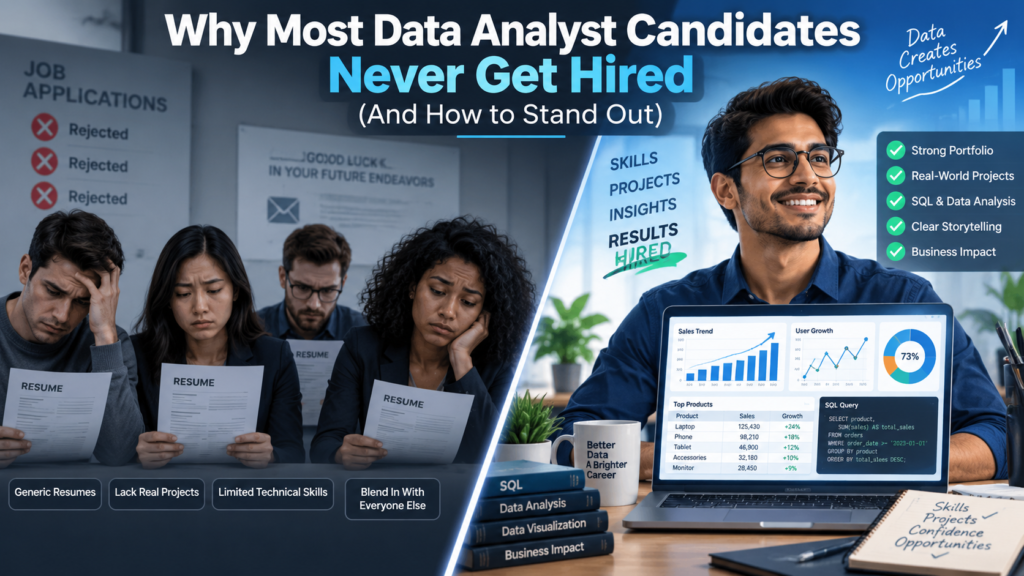
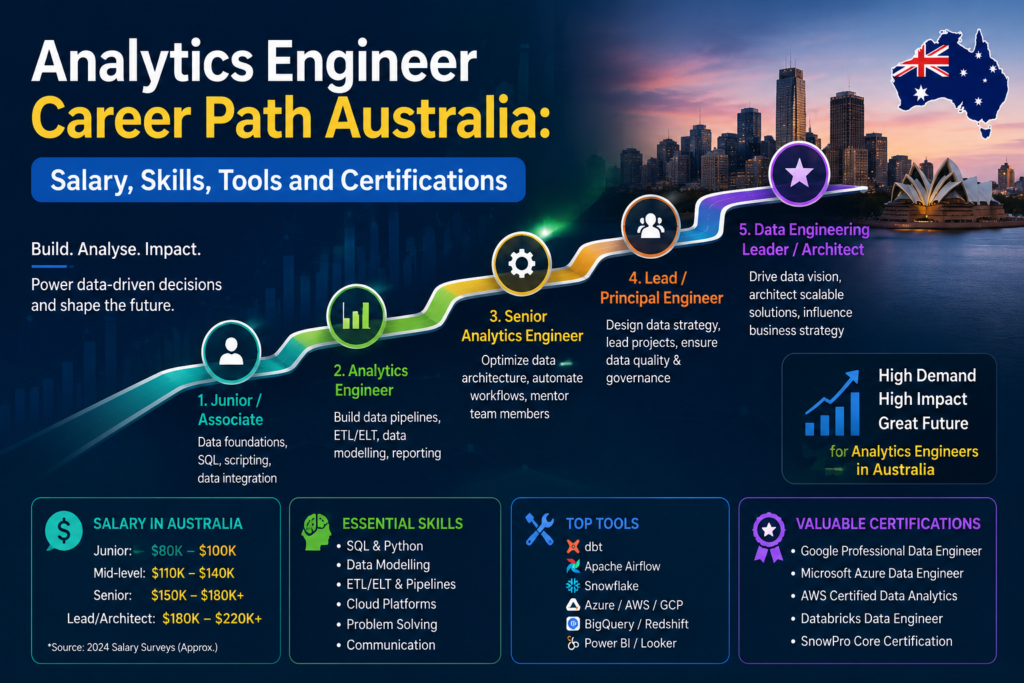
For a deeper breakdown of the full data analyst pathway, see our guides on Data Analyst Career Path in Australia: Skills, Jobs and Roadmap for 2026 and Why Most Data Analyst Candidates Never Get Hired (And How to Stand Out). If you’re preparing for interviews once your skill gaps are closed, our Data Analyst Interview Questions and Answers for Australia (2027 Guide) is a useful next step.
Build advanced Power BI skills through powerbicourse.au, and add cloud data fundamentals through azurecertifications.au. Both are delivered through Logitrain, Australia’s IT training provider.
Data Analyst Skills Training Across Australia
Employers in every major Australian market are hiring for this broader skill set, including:
- Sydney — financial services and enterprise employers prioritising SQL and stakeholder communication.
- Melbourne — strong demand across government, retail, and health analytics teams.
- Brisbane — growing analyst demand tied to infrastructure and public sector reporting.
- Perth — resources and energy sector analysts needing cloud and modelling skills.
- Adelaide — defence and government-aligned data analytics roles.
- Canberra — federal government data and reporting roles with a strong governance focus.
Frequently Asked Questions
Is Power BI alone enough to get a data analyst job in 2026?
No. Power BI is now considered a baseline expectation. Employers also look for SQL, data modelling depth, statistical reasoning, and the ability to communicate findings to business stakeholders.
What is the most important skill to add to a Power BI-only resume?
SQL. It’s the most consistently requested skill in Australian data analyst job ads and directly addresses the biggest gap employers report in Power BI-only candidates.
Do data analysts need to learn Python?
Not always, but roles that pay more and involve advanced analysis or automation increasingly expect at least basic Python, particularly with pandas.
What certification best complements Power BI skills?
Microsoft’s PL-300 validates advanced Power BI ability, while Azure Data Fundamentals (DP-900) adds the cloud data literacy employers increasingly expect alongside it.
How do I demonstrate business storytelling skills without job experience?
Practise presenting findings from a personal project as a business recommendation rather than a technical summary, and include this framing in your portfolio and interview answers.
Final Thoughts
Power BI got you in the conversation, but it won’t win you the role on its own. The skills employers expect from data analysts in 2026 span SQL, data modelling, statistical reasoning, cloud literacy, and above all, the ability to turn a dashboard into a business decision. Close those gaps deliberately and Power BI becomes one strong tool in a genuinely competitive analyst skill set, rather than the whole story.