

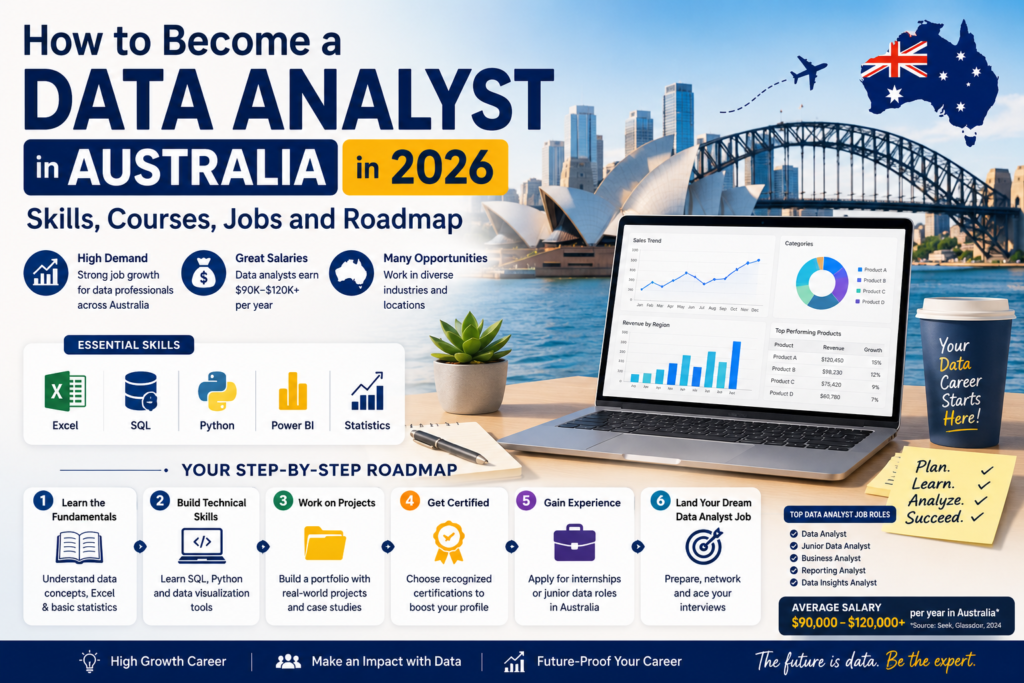
Becoming a data analyst in Australia in 2026 doesn’t require a computer science degree, a maths PhD, or years of guessing. It requires a clear order of operations: the right foundational skills, a couple of recognised tools, one solid certification, a small portfolio of real projects, and a job search aimed at the roles actually hiring right now. This guide walks through that path step by step, with the courses, certifications and city-specific options that make it achievable whether you’re starting from Melbourne, Sydney, Brisbane, or anywhere else in the country.
If you’ve been searching “data analyst course Australia” or “how do I even start,” this is the roadmap—no fluff, no unnecessary detours. If you’d like expert guidance on choosing the right training path or career direction, contact our team on 1800 159 151 for personalised assistance.
Why Data Analytics Is One of Australia’s Fastest-Growing Careers
Every industry in Australia now runs on data banking, retail, healthcare, government, mining, logistics. Someone has to turn spreadsheets, dashboards and databases into decisions leadership can act on, and that’s the data analyst. Demand has stayed strong across Sydney’s finance and consulting sector, Melbourne’s retail and healthcare analytics teams, and Brisbane’s logistics, government and construction employers, which means the skills gap isn’t closing on its own it’s opening up more entry points for people willing to learn properly.
What Does a Data Analyst in Australia Actually Do?
Day to day, a data analyst pulls data from spreadsheets or databases, cleans it, looks for patterns, and turns the result into something a manager can use a dashboard, a report, a forecast, or a one-page summary. It’s less about complex algorithms and more about accuracy, clarity and knowing which question actually matters. That combination of technical skill and plain-English communication is exactly what separates people who get hired from people who don’t.
Core Skills You Need to Become a Data Analyst in Australia
Excel Still the Foundation
Almost every analyst role starts with an Excel data analytics course Australia employers can see on a resume PivotTables, lookups, and clean data structures are still the daily reality in most teams, even ones using more advanced tools on top.
SQL Non-Negotiable
SQL for data analysts is how you pull information straight from a company’s database instead of waiting for someone to export it for you. A SQL course Australia employers respect will cover joins, filtering, aggregation and writing queries against real, messy data not just toy examples.
Power BI and Data Visualisation
A Power BI course Australia teaches you to turn raw numbers into dashboards executives actually read. Power BI dashboard course Australia content typically covers data modelling, DAX formulas, and building reports that update automatically one of the most requested skills in current job ads.
Python for Data Analysis
Python for data analytics Australia training isn’t required for every entry-level role, but it opens up higher-paying positions fast. A Python data analysis course Australia typically covers Pandas, data cleaning at scale, and basic automation skills that separate a junior analyst from someone ready for a senior data analyst or business intelligence role.
Business Context and Communication
A business analytics course Australia component ties the technical skills together understanding what the business actually needs, and explaining findings in a way non-technical stakeholders can act on. This is the skill most courses underweight, and the one hiring managers mention most often.
Step-by-Step Roadmap to Become a Data Analyst in Australia in 2026
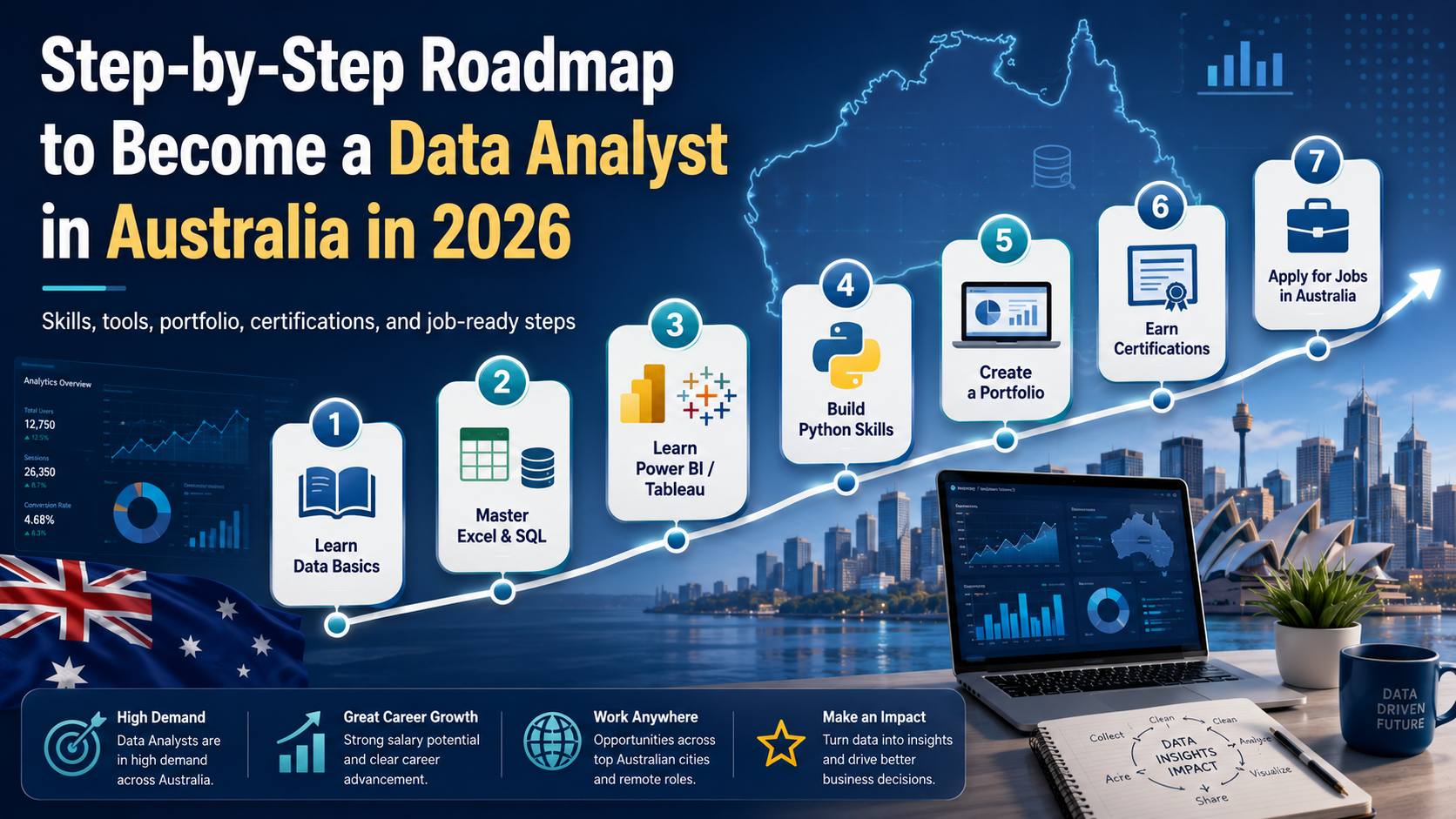
- Step 1 — Lock in Excel fundamentals. Start with a beginner data analytics course Australia or dedicated Excel training so formulas, PivotTables and clean data habits become second nature.
- Step 2 — Learn SQL. Move into an SQL course Australia focused on real business questions sales trends, customer segments, inventory checks not just syntax.
- Step 3 — Master Power BI. Take a Power BI course Australia to build dashboards and reports; this is the tool most Australian employers expect analysts to know.
- Step 4 — Add Python. A Python data analytics course Melbourne, Sydney or Brisbane (or online) adds automation and larger-scale data handling to your toolkit.
- Step 5 — Build 3–4 real portfolio projects. Use public datasets to build a dashboard, a SQL query set, and a short written analysis this is what recruiters actually look at, more than the certificate itself.
- Step 6 — Get one recognised certification. PL-300 certification Australia (Microsoft’s Power BI credential) or a CompTIA Data+ course Australia both signal job-readiness without requiring a full degree.
- Step 7 — Apply for entry-level and job-ready roles. Target titles like Junior Data Analyst, Reporting Analyst, or Business Intelligence Analyst these are the standard entry points into the field.
Best Data Analytics Courses and Certifications in Australia
Not every data analytics course Australia offers is built the same way. A few categories to know:
- Job ready data analytics course Australia — structured, sequential programs covering Excel through Power BI and SQL, often with a portfolio component and career support.
- Data analytics bootcamp Australia — intensive, fast-paced options for people who want to reskill quickly, usually full-time over several weeks.
- Data analytics short course Australia — focused single-skill courses (just SQL, just Power BI) for people upskilling one tool at a time.
- Data analytics course with certificate Australia — online, self-paced options that still provide a certificate for your resume and LinkedIn profile.
On the certification side, three names come up constantly in Australian job ads:
PL-300 course Australia (Microsoft Certified: Power BI Data Analyst Associate) the most widely recognised Power BI credential, detailed on Microsoft’s official PL-300 certification page.
CompTIA Data+ course Australia and the more advanced CompTIA DataX course Australia vendor-neutral certifications covering data concepts, mining and visualisation, outlined on CompTIA’s official Data+ page.
Azure Data Fundamentals course Australia a solid entry point if you’re heading toward cloud-based data roles, covered in Microsoft Learn’s Azure Data Fundamentals path.
Data Analytics Training Across Melbourne, Sydney and Brisbane
If you’d rather train with local context and support, here’s where to start:
At Data Analytics Courses Australia, programs run from beginner data analytics course Australia level through to full job ready data analytics course Australia pathways covering SQL, Power BI, Python and business analytics.
- Data analytics course Melbourne — including SQL course Melbourne, Power BI course Melbourne and Python data analytics course Melbourne options for retail, healthcare and finance-focused teams.
- Data analytics course Sydney — SQL course Sydney, Power BI course Sydney and business analytics course Sydney training aligned to the city’s finance and consulting job market.
- Data analytics course Brisbane — SQL course Brisbane, Power BI course Brisbane and data analytics bootcamp Brisbane options suited to logistics, government and construction employers.
Every city offers online data analytics course Australia options too, so location doesn’t have to limit which data analyst course Australia program you choose.
How Much Do Data Analysts Earn in Australia in 2026?
Salary figures vary by source and method, but current listings consistently put data analyst pay in Australia in a similar band. According to SEEK’s career advice pages, the average data analyst salary in Australia currently sits between roughly $95,000 and $115,000 a year, with entry-level roles typically starting lower and senior analysts in finance, consulting or tech earning noticeably more. Sydney and Melbourne tend to sit at the higher end of that range, while Brisbane and Perth have both been catching up as demand grows outside the traditional finance hubs.
These are general market indicators rather than guarantees always check current listings for your city and experience level before making a career decision.
Data Analyst Job Titles and Where to Find Jobs in Australia
Entry-level and early-career roles to search for include Junior Data Analyst, Reporting Analyst, Data & Insights Analyst, Business Intelligence (BI) Analyst, and Business Analyst (Data). Most Australian data analyst jobs are listed on SEEK, LinkedIn and Indeed, and increasingly ask for a working knowledge of SQL and Power BI even at graduate level one more reason to have both on your resume before you start applying.
Data Analyst in Australia: Frequently Asked Questions
Do I need a university degree to become a data analyst in Australia?
No. Many working data analysts in Australia come from unrelated degrees, or no degree at all, and moved into the field through a data analyst course Australia, a certification like PL-300, and a portfolio of real projects. A degree can help for graduate programs at large banks or consultancies, but it isn’t a strict requirement for most entry-level roles.
Is data analytics still worth learning in 2026 with AI tools improving?
Yes AI tools speed up cleaning and first-draft analysis, but someone still needs to ask the right question, validate the output, and explain it to stakeholders. Employers are asking for analysts who can use AI well, not analysts who’ve been replaced by it.
Which certification should I get first: PL-300 or CompTIA Data+?
If your target roles mention Power BI specifically (common in Australian job ads), start with the PL-300 certification Australia pathway. If you want a broader, tool-neutral credential covering data concepts generally, a CompTIA Data+ course Australia is the better first step.
How long does it take to become job-ready as a data analyst?
Most people following a structured job ready data analytics course Australia path Excel, SQL, Power BI, one certification, a small portfolio can reach an entry-level standard in three to six months of consistent study, faster with an intensive data analytics bootcamp Australia format.
Do I need Python, or is SQL and Power BI enough?
SQL and Power BI are enough for most entry-level and junior data analyst roles in Australia. Python for data analytics Australia becomes more valuable as you move toward senior analyst, analytics engineer, or business intelligence roles that involve larger datasets or automation.
Are online data analytics courses in Australia respected by employers?
Yes, particularly when the course includes a recognised certification and a portfolio component. An online data analytics course Australia works well for people balancing study with a current job, as long as it covers the same core skills Excel, SQL, Power BI and business communication as an in-person option.
What’s the difference between a data analyst and a business analyst in Australia?
A data analyst focuses on the numbers cleaning, analysing and visualising data. A business analyst focuses more on processes and requirements, translating business problems into technical or operational solutions. The two roles overlap heavily in smaller Australian companies, and a business analytics course Australia is useful groundwork for either path.
Final Thoughts
Becoming a data analyst in Australia in 2026 comes down to sequencing: Excel first, SQL and Power BI next, a portfolio of real projects, one solid certification, and a job search targeted at the roles actually hiring. Skip the overwhelm of trying to learn everything at once follow the roadmap above, choose a data analytics course Australia program that matches where you’re starting from, and you’ll be job-ready faster than trying to piece it together alone.