
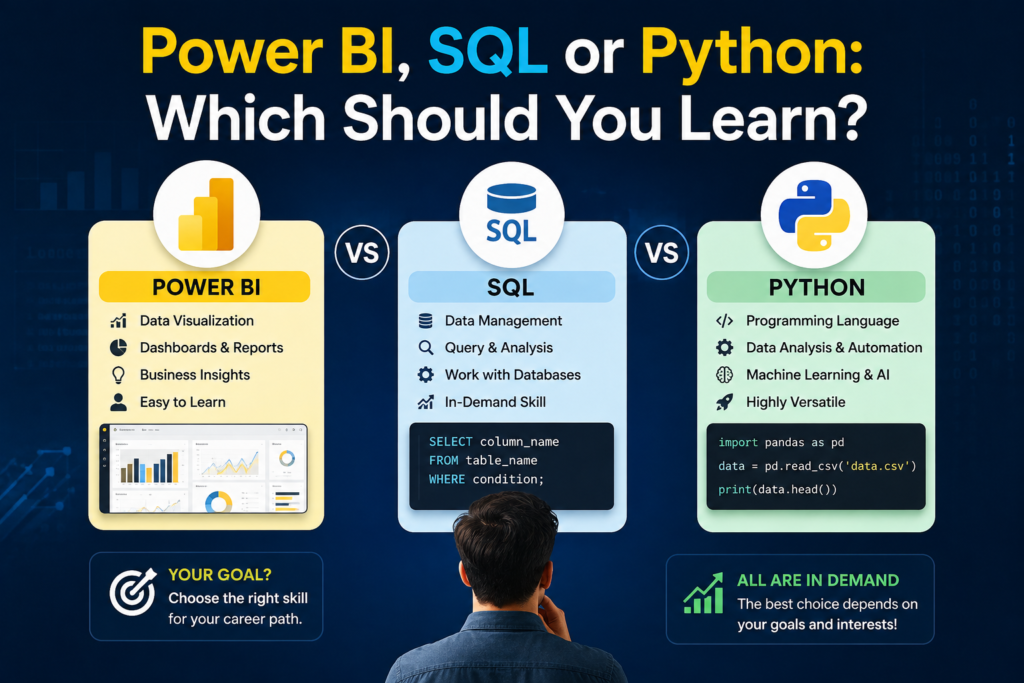


SQL vs Power BI vs Python salary Australia is one of the most-searched questions among career changers and data professionals right now and for good reason. Every job ad seems to want a different combination of the three, and the pay gap between them can be tens of thousands of dollars a year. If you’re deciding what to learn first, or what to add next to boost your pay, this guide breaks down real 2026 Australian salary data for SQL, Power BI, and Python so you can pick the path that actually pays.
SQL vs Power BI vs Python Salary Australia: The Quick Comparison
| Skill | Typical Australian Salary Range (2026) | Best For |
| SQL (core/entry) | AU$75,000 – $115,000 | Getting your first analyst role |
| Power BI (analyst/developer) | AU$70,000 – $150,000+ | BI Analyst, BI Developer, dashboard roles |
| Python (data analytics/science) | AU$95,000 – $215,000+ | Senior analyst, data scientist, ML roles |
These are base salary ranges before superannuation and bonuses. The pattern holds across every recent Australian salary survey: SQL is the entry ticket, Power BI adds a meaningful premium in reporting-heavy industries, and Python is the skill most consistently linked to six-figure and senior salaries.
SQL Salaries in Australia: The Non-Negotiable Skill
SQL is rarely the highest-paid skill on its own, but almost no data role exists without it. Analysts who pair SQL with a BI tool and land a Business Intelligence Developer title in Australia earn an average base salary of roughly AU$131,992, with typical packages sitting between $121,000 and $144,000. Entry-level analysts with solid SQL fundamentals, joins, and window functions typically start between $68,000 and $85,000, moving toward $95,000–$115,000 once they reach a mid-level position.
The takeaway: SQL alone won’t top the salary charts, but it’s the foundation every higher-paying pathway is built on. If you’re starting from zero, our SQL for Data Analysis – Beginner course is designed to get this foundation job-ready fast.
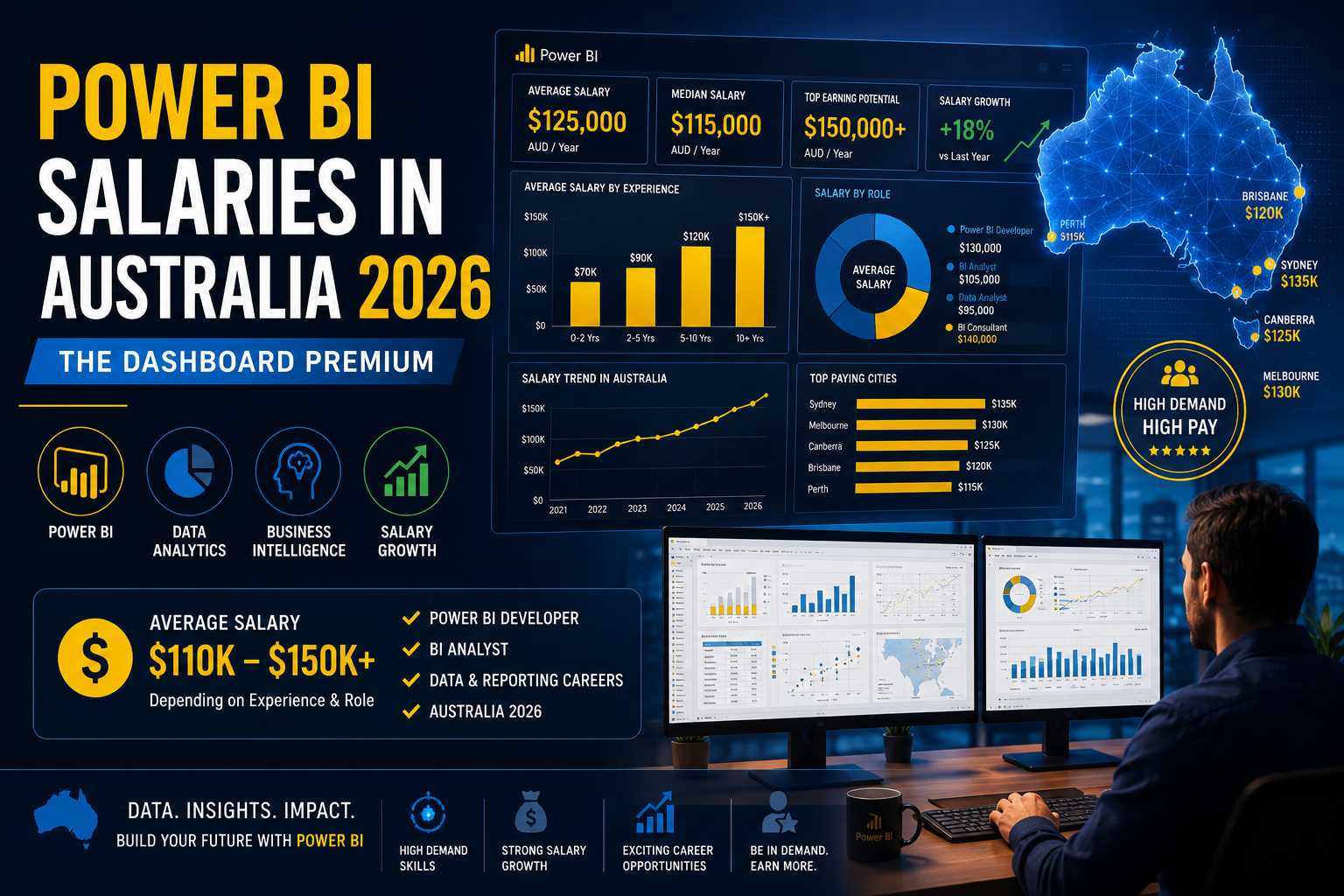
Power BI Salaries in Australia: The Dashboard Premium
Power BI is where a lot of Australian employers are willing to pay a specific premium, because dashboards and executive reporting are visible, high-impact work. Power BI developers in Australia typically earn between $70,000 and $120,000, with entry-level roles (1–3 years) sitting around $70,000–$90,000 and experienced developers (5+ years) reaching $120,000 to $150,000 or more. Business Intelligence Analyst roles average around $85,000, climbing significantly once DAX, data modelling, and enterprise dashboard architecture are added to the skill set.
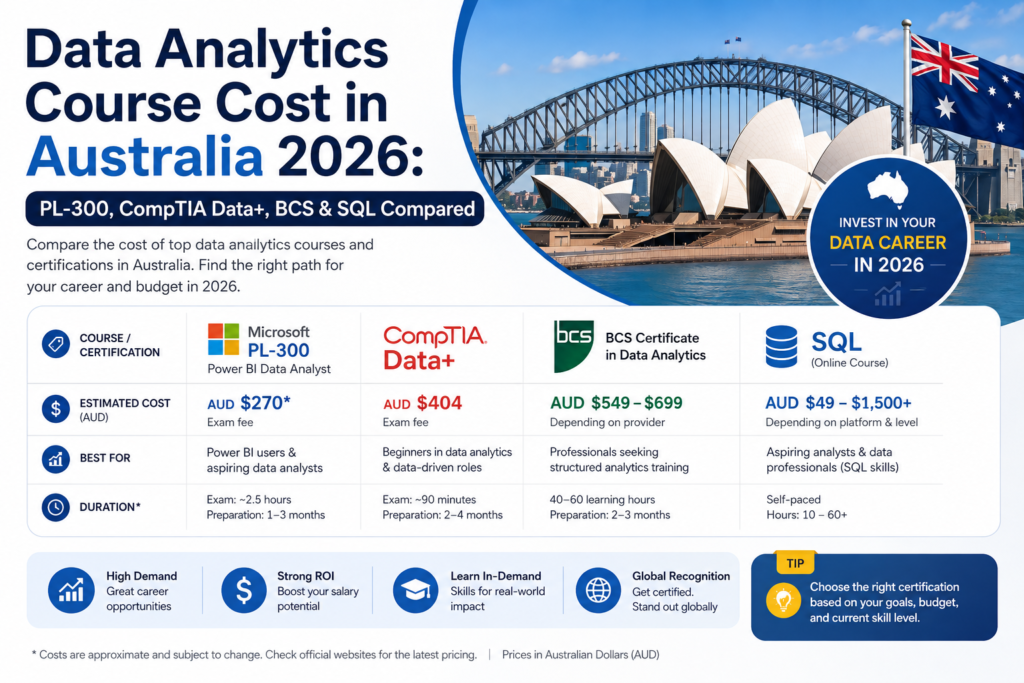
Employers increasingly shortlist candidates holding a Microsoft Power BI Data Analyst Associate (PL-300) certification alongside a portfolio of real dashboards. If you want to build that exact skill set, our Power BI Fundamentals course and Advanced Power BI Data Modelling course both map directly to what’s being hired for right now, and the Microsoft PL-300 course prepares you for the certification employers actively screen for.
Python Salaries in Australia: The Highest Ceiling
Python is consistently the skill with the biggest upside. Adding Python to an existing SQL and Power BI skill set can add $10,000 to $20,000 in salary on its own, and it’s the clearest pathway from data analyst into data scientist territory. Australian data scientists currently earn around $115,000 to $135,000, with senior data scientists working in machine learning and AI roles reaching $180,000 to $215,000 in major capital cities. Even basic Python scripting with Pandas can push a data analyst salary past the $100,000 mark faster than any other single skill addition.
Python is also the common thread in the highest-paying industries: finance and fintech data roles in Australia pay $130,000–$150,000, and IT and cloud services data analyst roles reach $135,000–$160,000, almost all of which list Python alongside SQL as a requirement.
Which Skill Should You Learn First?
If you’re mapping out a learning order, here’s the pathway that matches what Australian employers are actually hiring for in 2026:
- SQL first. It’s required in the vast majority of data job listings and it’s the fastest way to become employable.
- Power BI second. It turns your SQL output into something stakeholders can actually use, and it’s where a lot of entry-to-mid salary jumps happen.
- Python third. Once you’re comfortable querying and visualising data, Python is what moves you from “reporting” into “analysis,” and it’s the strongest lever for reaching senior salaries.
This is also the order our Data Analytics Learning Pathway is built around — Excel and SQL essentials, then dashboards and reporting in Power BI, then Python analytics fundamentals.
SQL vs Power BI vs Python Salary by City in Australia
Location still matters, even with hybrid and remote work reducing some of the gap. Here’s how the major cities compare for data analytics roles that use SQL, Power BI, and Python:
- Sydney — Highest average pay nationally, with mid-level analysts earning $93,000–$115,000, driven by the concentration of banks and financial services firms. See our data analytics courses in Sydney.
- Melbourne — Close behind Sydney at $88,000–$110,000, strong across finance, healthcare, and retail. See our data analytics courses in Melbourne.
- Brisbane — Around $107,500 base in logistics, government, and construction, with growing tech and resources demand. See our data analytics courses in Brisbane.
- Perth — Strong demand from mining, energy, and resources, sectors that lean heavily on Power BI and SQL reporting. See our data analytics courses in Perth.
- Adelaide — Defence, health, and manufacturing are the biggest employers of analytics talent. See our data analytics courses in Adelaide.
- Canberra — Government and public sector roles dominate, with steady demand for SQL and Power BI skills. See our data analytics courses in Canberra.
Beyond the Tools: What Actually Pushes Salaries Higher
Technical skills get you shortlisted, but they’re increasingly “table stakes” rather than the deciding factor. The analysts earning the biggest jumps in Australia are the ones who can connect SQL queries, Power BI dashboards, or Python models back to a business outcome reduced costs, faster reporting, better forecasting. That’s why courses built around real business scenarios, not just software features, tend to translate into faster salary growth. It’s also why certifications like CompTIA Data+, Azure Data Fundamentals, and the BCS Professional Certificate in Data Analysis are increasingly requested alongside tool-specific skills.
For a deeper look at how these numbers apply to your specific situation, see our related guides on data analyst salary in Australia, do you need SQL to become a data analyst, and PL-300 vs Data+ vs SQL course cost comparison.
Frequently Asked Questions
Does Python pay more than Power BI in Australia?
On average, yes. Python is more strongly linked to senior analyst and data scientist salaries, which top out well above typical Power BI developer roles. Power BI, however, often has a shorter learning curve and gets you into a well-paid role faster.
Can I get a high-paying data job with just SQL?
You can get hired with SQL alone, but the highest salaries almost always require at least one additional skill Power BI for reporting-heavy roles or Python for analytics-heavy roles.
Which pays more: Power BI or Python in Australia?
Power BI roles cluster in the $70,000–$150,000 range, while Python-heavy roles (data analyst to data scientist) stretch from $95,000 to $215,000+. Python has the higher ceiling; Power BI has strong, consistent mid-range demand.
What is the fastest way to increase my data analyst salary in Australia?
Based on current hiring data, adding Python to an existing SQL and Power BI skill set is the single biggest lever, often adding $10,000–$20,000 to a base salary within a year.
The Bottom Line
There’s no single “winner” between SQL, Power BI, and Python they solve different problems and get paid differently as a result. SQL is what makes you employable, Power BI is what makes your reporting valuable to leadership, and Python is what pushes your salary toward the top of the market. If your goal is the highest salary in Australia’s data job market, the real strategy is stacking all three, in that order.
Ready to build the exact skill combination employers are paying for? Explore our full course pathway or speak to a course advisor about the fastest route to a higher-paying data role.