



The data analyst career path in Australia offers strong opportunities across industries such as banking, retail, healthcare, government, and technology. A data analyst collects, cleans and interprets data to help a business make better decisions. In an Australian workplace, this typically means pulling data from CRM or ERP systems, building dashboards in Power BI or Tableau, writing SQL queries against a data warehouse, and presenting findings to non-technical stakeholders. No two roles look identical. A data analyst at a Melbourne bank may spend more time on regulatory reporting, while a Brisbane retail analyst is often focused on customer behaviour and sales trend analysis. What stays constant is the core toolkit: SQL, Excel, a BI platform, and increasingly, Python or R for deeper statistical work.
Why the Data Analyst Career Path in Australia Is Booming in 2026
Three forces are driving demand right now:
- Digital transformation — mid-size Australian firms that delayed cloud and analytics adoption are now catching up, and every migration needs analysts to make sense of the new data.
- AI adoption — companies rolling out AI tools still need humans to validate outputs, structure training data and interpret results, keeping analyst demand high rather than replacing it.
- Skills shortage — Australia’s tech skills gap means employers are hiring analysts with strong fundamentals and paying for training rather than waiting for a “perfect” candidate.
This mix of demand and undersupply is exactly why a structured data analyst career path in Australia rather than a scattered, self-taught approach gets people hired faster.
Core Skills You Need for a Data Analyst Career Path in Australia
Technical Skills
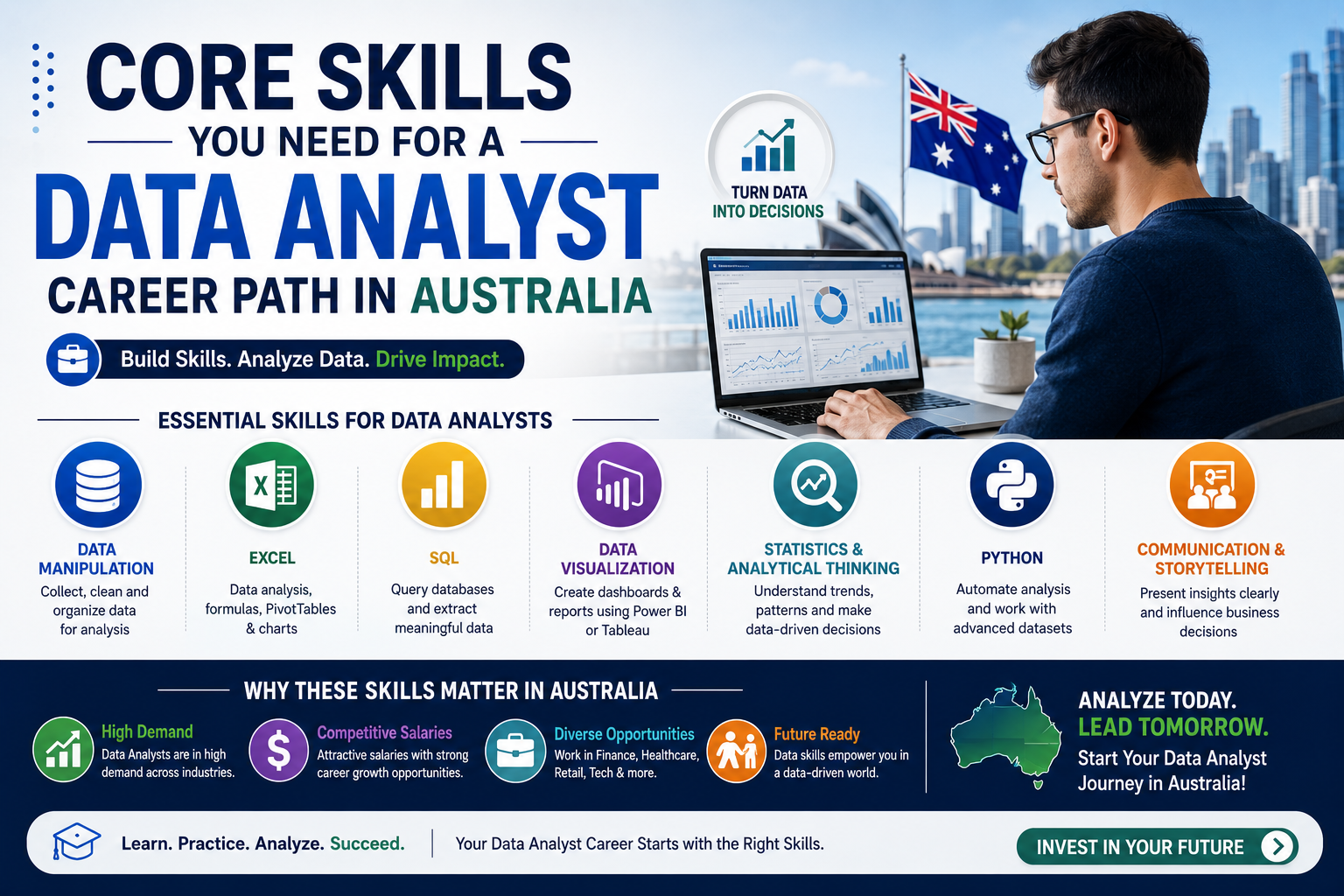
- SQL — the single most requested skill in Australian data analyst job ads, used to query and join large datasets.
- Excel — still the daily tool for quick analysis, pivot tables and reporting in most SMEs.
- Power BI or Tableau — dashboarding is now a baseline expectation. If you want a focused path into this tool, our Power BI course builds job-ready dashboard and DAX skills.
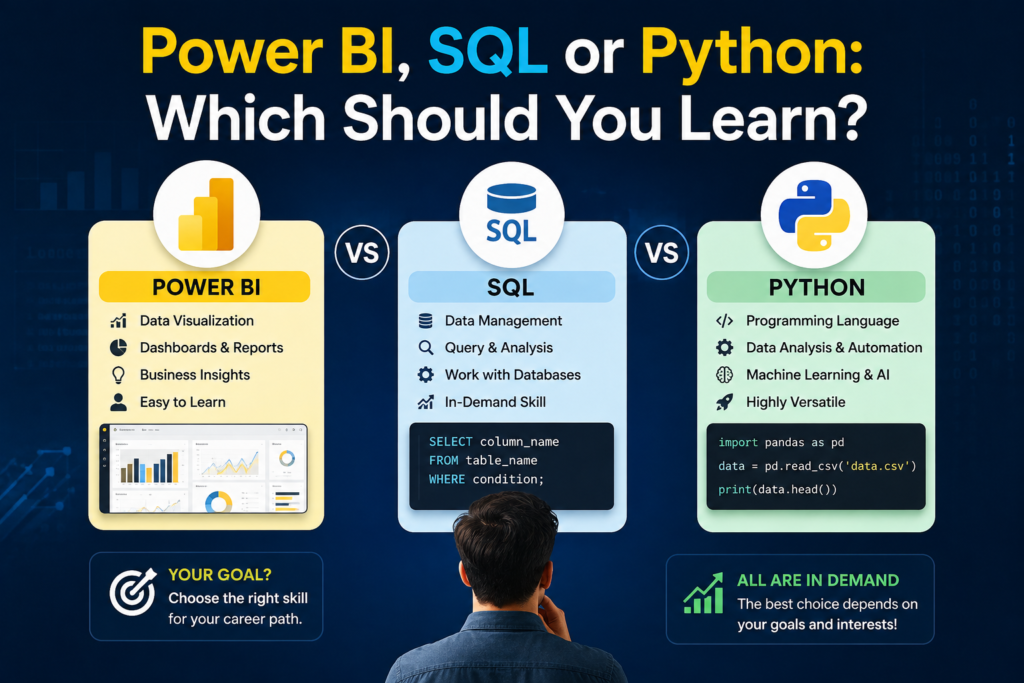
- Python or R — increasingly requested for statistical analysis, automation and preparing data for machine learning teams.
- Data cleaning and modelling — the unglamorous 60–70% of the job that separates analysts who get promoted from those who don’t.
Business and Soft Skills
- Communicating insights to non-technical stakeholders in plain English
- Understanding the industry you work in (finance, health, government, retail)
- Attention to detail when validating data quality
- Basic project and stakeholder management
Step-by-Step Roadmap for 2026
- Build the foundations — learn SQL and Excel to an intermediate level before touching anything else.
- Get certified — a structured, recognised program shortens the path and gives you a portfolio project. Our Data Analytics courses are built around exactly this outcome.
- Learn a BI tool properly — build 2–3 real dashboards using public datasets (ABS, Kaggle, data.gov.au).
- Add Python or R — even basic pandas/NumPy skills make you stand out from Excel-only applicants.
- Build a portfolio — 3–4 projects on GitHub or a simple portfolio site, each solving a real business question.
- Target entry roles — Junior Data Analyst, Reporting Analyst, or Business Analyst roles are common entry points.
- Keep learning on the job — analysts who move into Senior Analyst, Analytics Manager or Data Scientist roles within 3–5 years keep upskilling after job one.
Data Analyst Jobs and Salaries by City
Demand and pay vary noticeably across Australia, so your city matters when planning a data analyst career path in Australia.
- Sydney — the largest market, concentrated in finance, insurance and tech; typically the highest salaries nationally.
- Melbourne — strong demand from banking, retail and government, with a deep junior-to-mid market.
- Brisbane — growing fast on the back of government digital projects and logistics/retail analytics roles.
- Perth — mining, resources and energy companies drive steady demand for analysts who can handle operational data.
- Adelaide — defence, health and government sectors are expanding their analytics teams.
- Canberra — public service roles dominate, often requiring security clearance but offering strong job stability.
Wherever you’re based, entry-level roles generally start in the low-to-mid $70,000s, with mid-level analysts moving into the $90,000–$110,000 range and senior analysts and analytics leads well above that, depending on industry and city.
Certifications That Actually Help
Employers respond best to certifications tied to tools they already use Power BI, SQL and recognised data analytics programs carry more weight than generic “data science” badges for analyst-level roles. Logitrain runs instructor-led data analytics and Power BI training across major Australian cities with flexible online and classroom options, designed around the skills employers are actually hiring for.
Common Mistakes to Avoid
- Learning tools in isolation instead of building end-to-end projects
- Ignoring SQL because Excel feels “good enough”
- Applying only to Data Scientist roles when Data Analyst and Reporting Analyst roles are the realistic entry point
- Skipping the portfolio and relying on certificates alone
Data Analyst vs Data Scientist: Which Path Fits You?
Many beginners confuse the two. A data analyst focuses on describing what happened and why, using SQL, Excel and BI dashboards to report on existing data. A data scientist goes further, building predictive models with Python, R and machine learning. In Australia, the data analyst career path is the faster, more accessible entry point — most data scientists start as analysts first and specialise later once they’ve built strong SQL and statistics foundations.
Frequently Asked Questions
Is data analytics a good career in Australia in 2026?
Yes. Demand remains strong across finance, government, healthcare and retail, and the entry barrier is lower than most tech careers since it doesn’t require a computer science degree.
Do I need a degree to become a data analyst in Australia?
No. Many employers accept a certification plus a strong portfolio, especially for junior and reporting analyst roles. A recognised course such as Logitrain’s data analytics training can substitute for formal study.
How long does it take to become a data analyst?
With consistent study, most people reach job-ready level in 3–6 months, covering SQL, Excel, a BI tool and a small portfolio of projects.
Which Australian city has the most data analyst jobs?
Sydney and Melbourne have the largest volume of roles, but Brisbane, Perth, Adelaide and Canberra all have steady, growing demand, particularly in government and resources sectors.
Final Thoughts
The data analyst career path in Australia rewards people who combine solid fundamentals (SQL, Excel, a BI tool) with real projects and a bit of industry context. Whether you’re starting from scratch or moving across from a reporting or admin role, 2026 is a strong year to commit to the roadmap above. Explore Logitrain’s Data Analytics courses to get a structured, job-focused start.