

Snowflake vs Microsoft Fabric is quickly becoming the most-searched skills question for data analysts, data engineers and BI professionals planning their 2027 learning roadmap. Both platforms now sit at the centre of enterprise analytics, but they solve the problem in very different ways and that difference matters if you are deciding which certification, course or hands-on project to prioritise this year.
In this guide we break down what each platform actually does, where the Australian job market is heading, which one pays better, and most importantly which platform makes more sense for you to learn first, depending on your career goals.
What Is Microsoft Fabric?
Microsoft Fabric is an all-in-one, software-as-a-service analytics platform that bundles data engineering, data warehousing, real-time analytics, data science and Power BI into a single workspace built on a shared storage layer called OneLake. Instead of stitching together separate tools for ingestion, transformation, warehousing and reporting, Fabric keeps everything in one connected environment.
The standout feature for analysts is Direct Lake mode, which lets Power BI read data straight from OneLake without the slow import-and-refresh cycle that used to delay dashboards by hours. For organisations already using Microsoft 365, Azure and Power BI, Fabric reduces tool sprawl and licensing overhead significantly.
What Is Snowflake?
Snowflake is a cloud-native data platform built around one core idea: separating storage from compute so teams can scale each independently. It has spent years earning a reputation as the platform that “just works” for SQL-based analytics, without the need to manage servers, clusters or complex infrastructure.
Snowflake runs on AWS, Azure or Google Cloud, which makes it the natural choice for organisations that are multi-cloud rather than Microsoft-only. Its Marketplace and secure data-sharing features are also widely used for sharing datasets across companies without physically copying files, and its Cortex AI tools have matured into a genuine competitor for in-platform machine learning.
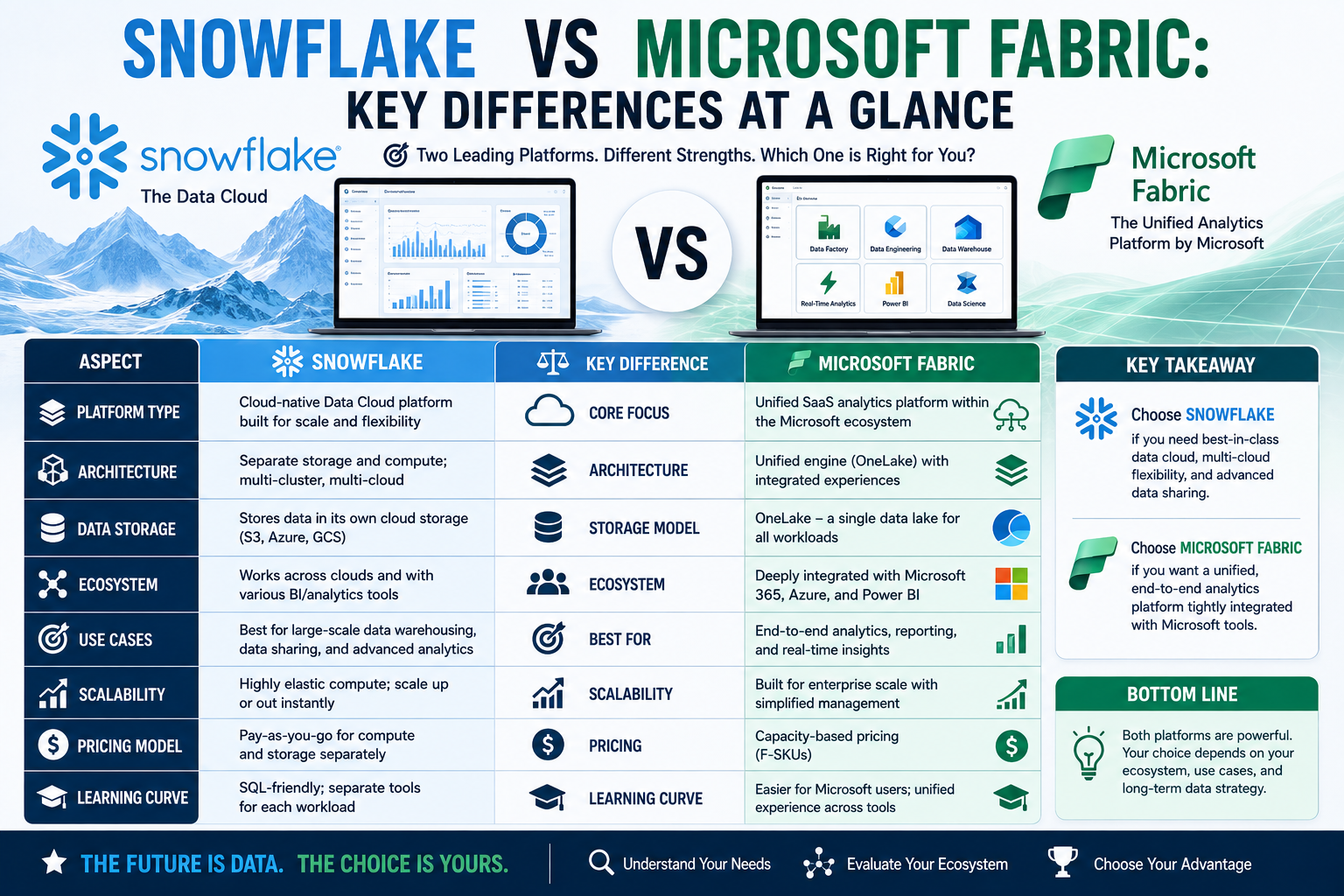
Snowflake vs Microsoft Fabric: Key Differences at a Glance
| Factor | Microsoft Fabric | Snowflake |
| Architecture | Unified SaaS suite on OneLake | Decoupled storage & compute |
| Best fit | Microsoft 365 / Azure organisations | Multi-cloud / cross-org organisations |
| Cloud support | Azure-centric | AWS, Azure, Google Cloud |
| BI tool | Power BI built in | Connects to Power BI, Tableau, Looker |
| Ideal use case | Reducing tool sprawl, real-time dashboards | External data sharing, SQL warehousing |
| Learning curve | Easier for existing Power BI / Azure users | Steeper start, simpler day-to-day ops |
Snowflake, by comparison, wins on cloud-agnostic flexibility, external data sharing, and pure SQL warehousing performance, while Fabric wins on integration, cost bundling and Microsoft-ecosystem depth. Neither platform is universally “better” the right answer depends on the employer you’re targeting.
Job Market Demand: Snowflake vs Microsoft Fabric in Australia
Both skill sets are in active demand across Australian job boards in banking, retail, healthcare and government. Employers hiring for Snowflake roles are typically looking for candidates comfortable with SQL, cloud architecture (AWS, Azure or GCP) and data engineering fundamentals. Microsoft Fabric roles, on the other hand, tend to sit inside existing Power BI and Azure teams, and increasingly ask for the Microsoft Fabric Analytics Engineer credential as a baseline requirement.
If you already work with Power BI or hold Azure Data Fundamentals, Microsoft Fabric is the shorter path to your next promotion. If you’re aiming for roles at multi-cloud or global companies, Snowflake experience tends to open more doors outside the Microsoft ecosystem.
Salary Comparison for Snowflake and Microsoft Fabric Skills
According to our own Data Analyst Salary in Australia 2026 guide, analysts with cloud-platform experience in tools such as Snowflake, Databricks or BigQuery can command roughly a 10–20% premium over generalist analysts, since that skill set reduces a company’s reliance on a dedicated data engineering team.
Microsoft Fabric skills carry a similar premium inside Microsoft-centric organisations, particularly for professionals who can bridge the gap between data engineering and reporting. For a broader look at how these two career tracks differ in pay and responsibility, see our guide on Data Analyst vs Data Engineer salaries in Australia.
Which Platform Is Easier to Learn in 2027?
For most working analysts, Microsoft Fabric has the gentler learning curve simply because it reuses skills you may already have in Power BI, Excel and SQL. The interface, the DP-605 certification path and the documentation are all built around a “single pane of glass” philosophy, so the ramp-up time is shorter.
Snowflake has a steeper initial learning curve because it assumes stronger SQL and cloud-architecture fundamentals from day one. However, once you understand the separation of storage and compute, the platform is considered easier to operate day-to-day than managing your own infrastructure, since Snowflake automates most optimisation and scaling decisions for you.
Snowflake vs Microsoft Fabric: Which Should You Learn First?
Choose Microsoft Fabric If…
- Your employer already runs Microsoft 365, Azure or Power BI.
- You want the fastest route from analyst to analytics engineer.
- You value having warehousing, pipelines and BI in one licence.
- You’re targeting real-time, executive-level dashboards.
Choose Snowflake If…
- You want to work across AWS, Azure or Google Cloud environments.
- Your target employer shares data externally with partners or clients.
- You’re building toward a data engineering or cloud architecture career.
- You want a credential that travels well outside the Microsoft ecosystem.
For a deeper look at Fabric specifically, read our companion article, Microsoft Fabric for Data Analysts: What You Need to Know in 2027.
How to Start Learning Microsoft Fabric or Snowflake in Australia
The most efficient starting point for Microsoft Fabric is our DP-605: Microsoft Fabric Analytics Engineer course, paired with Power BI Fundamentals and Azure Data Fundamentals if you’re new to the Microsoft stack. Strengthen the fundamentals first with our SQL for Data Analysis (Beginner) course, since SQL underpins both platforms.
All programs are available live online or in person across Sydney, Melbourne, Brisbane, Perth, Adelaide and Canberra, so you can train around your existing job.
If you’re deciding between certification paths and budgets, our PL-300 vs Data+ vs SQL cost comparison breaks down pricing across the most popular Australian data certifications.
Final Verdict: Snowflake vs Microsoft Fabric in 2027
There is no single winner in the Snowflake vs Microsoft Fabric debate only the platform that matches where you already work and where you want to work next. Microsoft Fabric is the pragmatic choice for analysts inside Microsoft-centric teams who want to move faster into analytics engineering. Snowflake remains the stronger long-term bet for anyone building a cloud-agnostic data engineering career or targeting global, multi-cloud employers.
The safest strategy for 2027 is not choosing one over the other permanently it’s building strong SQL foundations first, then specialising in whichever platform your target industry or employer already relies on. Explore our full course catalogue or speak to a course advisor to map out the fastest path for your goals.
FAQs: Snowflake vs Microsoft Fabric
Is Microsoft Fabric replacing Snowflake?
No. They serve overlapping but different needs Fabric is winning inside Microsoft-centric enterprises, while Snowflake continues to lead in multi-cloud and cross-organisation data sharing.
Which pays more, Snowflake or Microsoft Fabric skills?
Both carry a salary premium over generalist analyst roles in Australia. Snowflake tends to command a slightly higher premium in data engineering-heavy roles, while Fabric skills are increasingly required for Power BI-focused promotions.
Do I need to learn both platforms?
Not immediately. Start with strong SQL fundamentals, then choose based on your current employer’s stack or your target industry you can add the second platform later.