

If you’re weighing up whether Do you need SQL to become a data analyst in Australia, the short answer is: almost always, yes. Whether you’re applying for entry-level roles in Sydney, Melbourne, Brisbane, Perth, Adelaide, or Canberra, SQL (Structured Query Language) shows up in the majority of data analyst job ads as a core requirement, not a nice-to-have. This 2026 guide breaks down exactly how much SQL you need, what Australian employers expect, and how it compares to Excel and Python.
What Does a Data Analyst Actually Do in Australia?
A data analyst collects, cleans, and interprets data to help a business make better decisions – things like sales trends, customer behaviour, operational efficiency, or financial performance. In practice, this means pulling data out of a database, shaping it into something usable, and presenting it clearly through dashboards or reports using tools like Power BI or Tableau.
Do You Need SQL to Become a Data Analyst?
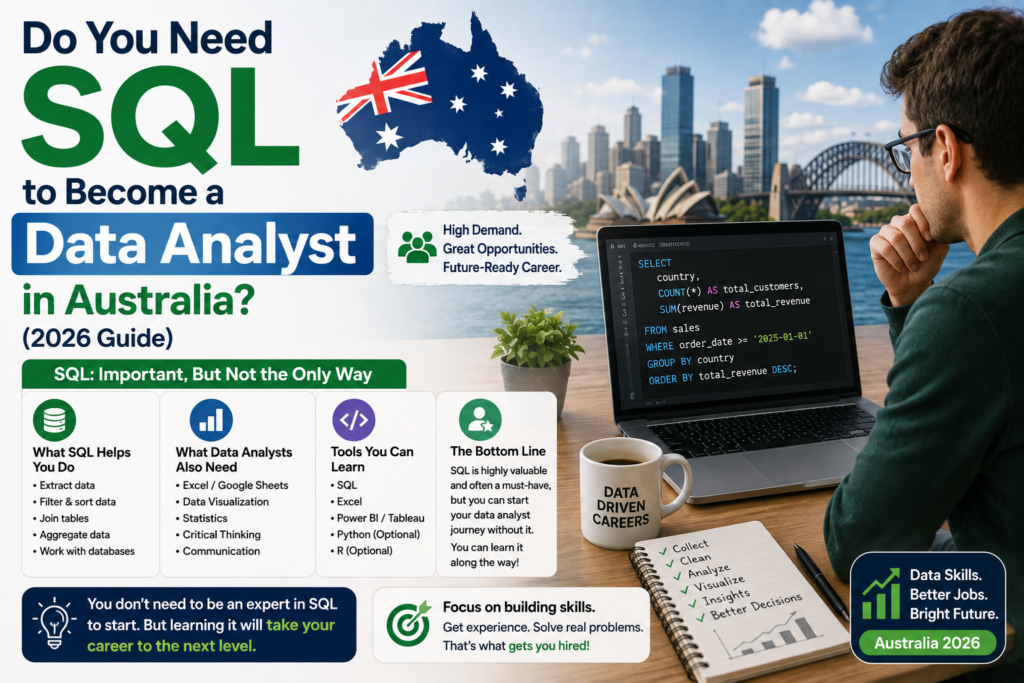
Yes – in most cases. Almost every data analyst job ad in Australia lists SQL as a required or highly preferred skill, because most business data lives inside relational databases (SQL Server, PostgreSQL, MySQL) rather than a spreadsheet. Without SQL, you’re limited to whatever data someone else has already exported for you, which significantly narrows the roles you can apply for.
There are a small number of analyst-adjacent roles – particularly reporting-heavy Excel roles in smaller businesses – where SQL isn’t essential on day one. But for genuine data analyst titles at mid-to-large Australian companies, SQL is close to non-negotiable.
Why SQL Matters So Much for Data Analyst Roles
- Most company data sits in SQL-based databases, not spreadsheets
- SQL lets you pull exactly the data you need instead of waiting on someone else to export it
- It’s the common language across almost every BI tool – Power BI, Tableau, and Looker all connect to SQL databases
- Employers use SQL tests in interviews as a quick way to filter genuine analysts from spreadsheet users
SQL vs Excel vs Python What’s the Difference for Data Analysts?
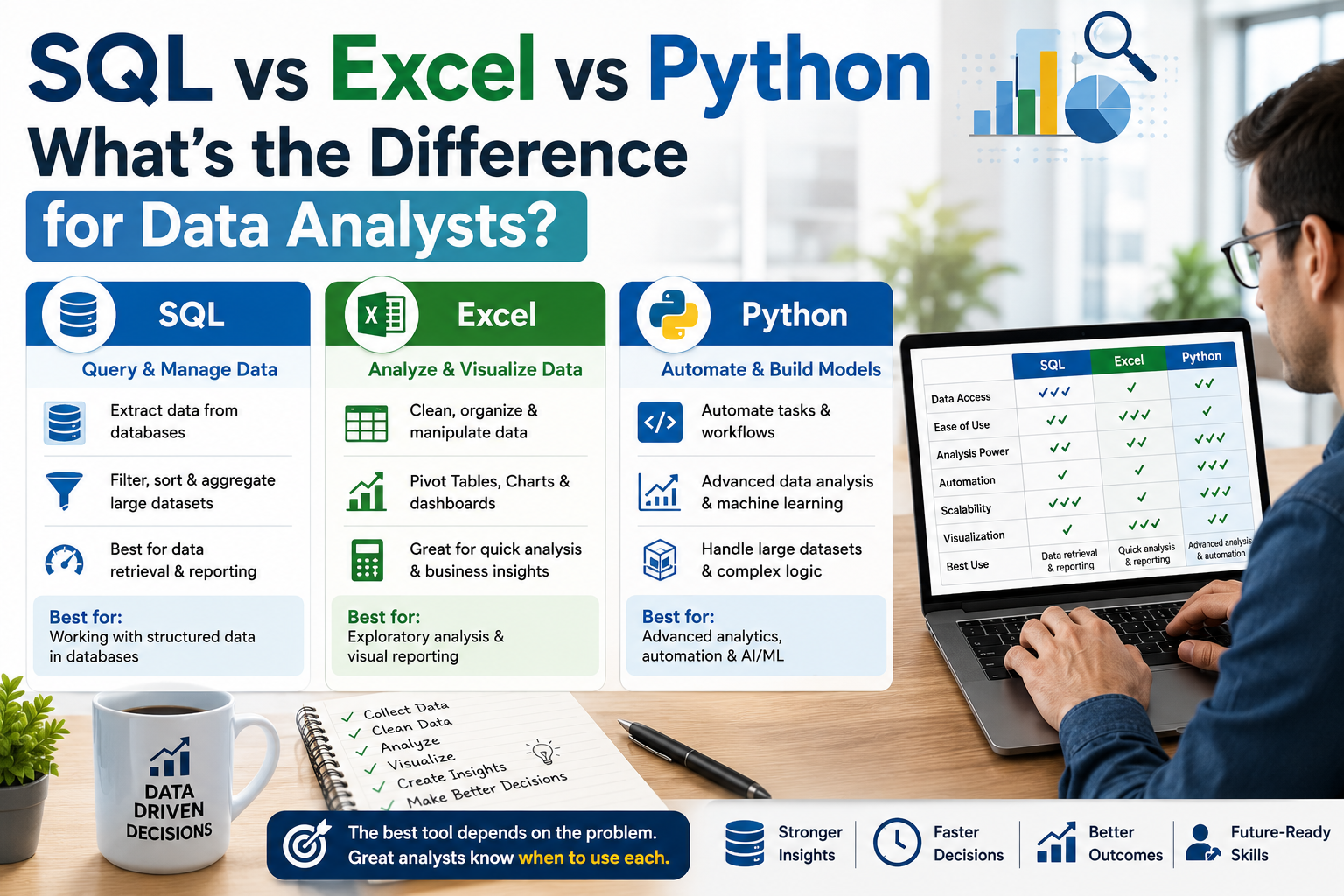
Excel is best for smaller datasets, quick calculations, and reporting you build yourself.
SQL is how you retrieve and combine large volumes of data directly from a company’s database – this is usually the first step before Excel or Power BI even comes into play.
Python becomes useful once you’re doing more advanced statistical analysis or automation, but it’s typically a step beyond core data analyst requirements, not a replacement for SQL.
Most Australian data analyst roles expect SQL plus one visualisation tool (Power BI or Tableau) as the baseline. Python is a bonus, not a starting requirement.
Data Analyst Job Market in Australia (2026)
Demand for data analysts remains strong across Australia’s major cities, with slightly different flavours depending on the region:
- Sydney and Melbourne – the largest concentration of data analyst roles, especially in finance, banking, and retail
- Brisbane and the Gold Coast – growing demand in logistics, healthcare, and government
- Perth – strong demand in mining, resources, and energy reporting
- Adelaide – defence, agribusiness, and public sector analytics roles
- Canberra – government and policy-focused data and reporting roles
Job boards like Seek consistently show SQL listed alongside Excel and Power BI as core requirements across these regions, regardless of industry.
How Much SQL Do You Really Need to Learn?
You don’t need to master every advanced SQL feature to land your first data analyst role. Most entry-level positions expect you to be comfortable with the following:
Basic SQL Every Beginner Should Master
- SELECT and WHERE – retrieving and filtering specific data
- JOIN – combining data from multiple tables
- GROUP BY and aggregate functions (SUM, COUNT, AVG) – summarising data
- ORDER BY – sorting results
- Basic subqueries – nesting one query inside another
Sample SQL Query Every Beginner Should Understand
Here’s a simple example a junior data analyst might write to find total sales by region for the current year:
SELECT region, SUM(sales_amount) AS total_sales
FROM sales_transactions
WHERE YEAR(sale_date) = 2026
GROUP BY region
ORDER BY total_sales DESC;
This single query replaces what could take hours to do manually in a spreadsheet – which is exactly why employers value SQL so highly.
Other Skills Australian Employers Look For Alongside SQL
- Excel – still widely used for quick analysis and ad hoc reporting
- Power BI or Tableau – for building dashboards and visual reports
- Basic statistics – understanding averages, trends, and correlation
- Communication skills – explaining data findings clearly to non-technical stakeholders
How to Learn SQL for Data Analytics in Australia (2026)
If you’d rather learn with structured lessons than piece it together from scattered tutorials, Data Analytics Courses Australia runs beginner-to-advanced SQL and data analytics training built specifically for the Australian job market – including practical exercises based on real business reporting scenarios.
Explore the full SQL for Data Analysts course pathway to go from your first SELECT statement to building complete reporting queries, or browse the complete course library if you also want to build your Power BI and Excel skills alongside SQL.
Frequently Asked Questions
Can I become a data analyst without SQL?
It’s possible for a small number of Excel-heavy reporting roles, but the vast majority of genuine data analyst positions in Australia list SQL as a required skill, so learning it significantly widens your job options.
Is SQL harder to learn than Excel?
Not really – SQL has a smaller set of core commands than most people expect, and many beginners become comfortable with the basics within a few weeks of regular practice.
Do I need Python as well as SQL?
Not for most entry-level roles. SQL plus a visualisation tool like Power BI is the standard baseline; Python is a valuable bonus skill rather than a starting requirement.
Which SQL should I learn – MySQL, PostgreSQL, or SQL Server?
The core language is almost identical across all three, so start with any of them – most employers care that you understand SQL fundamentals, not which specific database platform you learned on.
Final Thoughts
So, do you need SQL to become a data analyst in Australia? For almost every genuine data analyst role, yes – and it’s one of the highest-return skills you can add if you’re serious about the career. Start with the basics, practise on real datasets, and if you want a faster, guided path, enrol in a SQL for data analytics course built specifically for the Australian job market.