

An analytics translator is the person who turns a business question into a data question, and then turns the answer back into a decision someone can act on. Most Australian companies already employ analysts. What many are missing is the bridge between those analysts and the executives, managers and frontline teams who are supposed to use the numbers. That gap, not a shortage of dashboards, is why so many analytics investments quietly fail.
This guide explains why businesses need translators more than another round of analyst hires, what the role actually involves, the skills it demands, and how you can build those skills through practical SQL, Power BI and Azure training in Sydney, Melbourne, Brisbane, Perth, Adelaide and Canberra.
What Is an Analytics Translator?
An analytics translator is a hybrid professional who understands the business well enough to ask the right questions and understands data well enough to know what is realistic. The term was popularised by consultancies such as McKinsey, but the work itself has existed for years under many job titles: business analyst, insights partner, data product owner, BI lead, or simply “the person everyone trusts to explain the numbers”.
A translator doesn’t need to be the best coder in the room. They need to be the best communicator between rooms. They sit between the data team and the business, shaping the brief going in and the story coming out.
Why Analysts Alone Are Not Enough
Analysts are essential, and nothing here argues against them. The problem is what happens around them. Picture a retail chain whose head office asks for “a customer dashboard”. The analyst builds something technically excellent. Six weeks later nobody opens it, because the dashboard answered a question nobody was really asking. We explore that pattern in The Most Expensive Dashboard Is the One Nobody Uses.
This is the last-mile problem of data work. Insight is only valuable once it changes a decision. Three things usually get in the way.
- Vague briefs. Stakeholders describe symptoms (“sales feel soft”) rather than decisions (“should we cut the discount in Queensland stores?”).
- Jargon mismatch. Analysts talk about models, joins and confidence intervals. Leaders talk about margin, risk and customers. Neither side is wrong, but nobody is bridging them.
- No ownership of adoption. Delivering a report is treated as the finish line, when the real finish line is a behaviour change.
Adding more analysts to this system produces more reports, not more decisions. Adding a translator fixes the system.
Analyst vs Analytics Translator: The Real Difference

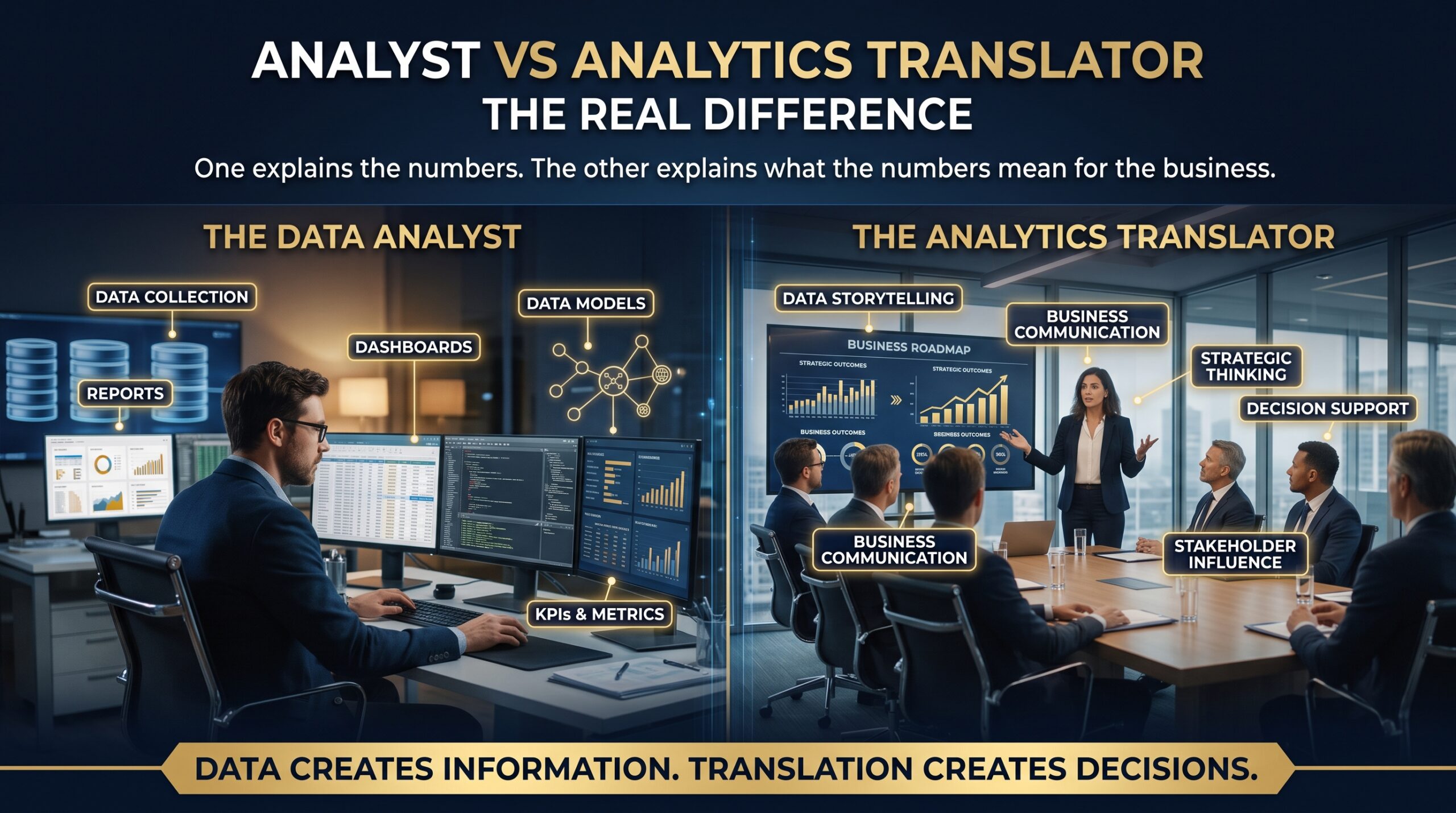
| Area | Data analyst | Analytics translator |
| Starting point | A dataset or a ticket | A business problem or decision |
| Core question | “What does the data show?” | “What should we do, and how will we know it worked?” |
| Main tools | SQL, Power BI, Excel, Python | Same tools, plus workshops, storytelling and KPIs |
| Audience | Data team and report users | Executives, managers and operational teams |
| Success measure | Accurate, timely reports | Decisions made, outcomes improved |
| Typical risk | Building what was asked, not what was needed | Over-promising without technical grounding |
The best organisations treat these as partners, not rivals. A strong analytics translator makes every analyst on the team more valuable, because the work they produce finally lands.
Five Signs Your Business Needs an Analytics Translator
- Dashboards are delivered on time but rarely opened after launch.
- Leaders still make big calls from gut feel or from a spreadsheet someone emailed.
- Analysts spend more time reworking requests than analysing data.
- Different teams quote different numbers for the same metric.
- Data projects get approved with enthusiasm and then stall without a clear owner.
If three or more of these sound familiar, your bottleneck is almost certainly translation rather than technology.
A Day in the Life of an Analytics Translator
Imagine a healthcare provider that wants to reduce missed appointments. The translator starts by interviewing clinic managers and learns the real decision: whether to send reminders earlier or add a phone follow-up. They convert that into a clear analytical question for the data team, agree what “success” looks like, and check that the data is clean enough to trust.
When the analysis returns, the translator doesn’t forward a 30-page deck. They present one page, with a recommendation, a confidence level and a simple pilot plan. Three months later they return with the results. That cycle of framing, analysing, explaining and following up is the heart of the role.
Core Skills Every Analytics Translator Needs
The good news is that these skills are learnable. They sit on top of solid technical foundations, which is why many translators begin as analysts or business professionals who upskill. The table below shows where to build each skill.
| Skill | What it looks like in practice | Where to build it |
| SQL and data access | Pulling and checking data without waiting on others | SQL for Data Analysis (Beginner) |
| Dashboards and BI | Designing reports leaders actually use | Power BI Fundamentals |
| Data modelling | Making sure metrics mean the same thing everywhere | Advanced Power BI Modelling |
| Cloud data literacy | Understanding where data lives and how it flows | Azure Data Fundamentals |
| Vendor-neutral foundations | Core analytics concepts, governance and quality | CompTIA Data+ |
| Certified analyst credibility | Proving skills to employers and stakeholders | Microsoft PL-300 |
| Structured analysis methods | Repeatable, professional approach to data work | BCS Data Analysis and Modelling |
Technical skills get you in the door. Three human skills make you a translator: data storytelling, stakeholder management and business acumen. Practise them by presenting every analysis as a recommendation, not a report.
How to Become an Analytics Translator in Australia
There isn’t a single qualification that creates an analytics translator, but there is a sensible path.
- Step 1: Get the data basics. Start with SQL and a BI tool. Our Power BI course and the SQL beginner course are a practical entry point.
- Step 2: Learn the business you serve. Pick an industry such as finance, healthcare, retail, education or government, and learn its key metrics and decisions.
- Step 3: Practise translating. Rewrite one of your reports as a single-page recommendation. Ask stakeholders what they would do differently after reading it.
- Step 4: Certify. A credential such as PL-300 signals technical credibility while you build leadership experience. Microsoft’s own Power BI documentation is a helpful free companion.
- Step 5: Grow into leadership. Avoid the trap of becoming a permanent report builder; our article on the report builder trap explains how top performers move beyond it.
If you are early in your career, you may also like why businesses pay more for people who turn data into decisions and what employers actually want from data analyst candidates.
Analytics Translator Opportunities Across Australian Cities
Demand for translation skills shows up wherever organisations have data but struggle to use it. Every major city has its own flavour, and each of our city pages explains local training options.
| City | Where translators are valued | Training page |
| Sydney | Finance, fintech, consulting and large retail | Data analytics courses Sydney |
| Melbourne | Healthcare, education, retail and state government | Data analytics courses Melbourne |
| Brisbane | Infrastructure, energy, tourism and public sector | Data analytics courses Brisbane |
| Perth | Mining, energy and resources operations | Data analytics courses Perth |
| Adelaide | Defence, health, manufacturing and growing tech | Data analytics courses Adelaide |
| Canberra | Federal government, policy and security analytics | Data analytics courses Canberra |
Prefer a classroom? Logitrain, our training partner, lists local options for IT courses in Sydney, Melbourne, Brisbane, Perth, Adelaide and Canberra. Every course is also available as live, instructor-led online training, and you can explore the full list on our courses page.
How Businesses Can Build Analytics Translator Capability
You don’t always need to hire externally. In many organisations the best future translator is already on the payroll: a senior analyst with strong people skills, or an operations lead who loves numbers. A few steps help.
- Name the role. Even a part-time analytics translator responsibility gives people permission to ask “what decision is this for?”
- Upskill in pairs. Train analysts in business context and business staff in data literacy so both sides learn the same language.
- Measure adoption, not delivery. Track how often reports are used and which decisions they influence.
- Invest in shared foundations. Consistent metric definitions and a modest Azure-based data platform skill base prevent endless debates about whose numbers are right. Teams building reporting skills can also explore Power BI training.
For organisations that want to upskill several people at once, in-house delivery is available. Speak with an advisor through our contact page.
Frequently Asked Questions About the Analytics Translator Role
What does an analytics translator do?
An analytics translator connects business leaders and data teams. They define the right questions, make sure the analysis answers them, and communicate results in plain language so decisions actually happen.
Is an analytics translator the same as a business analyst?
They overlap, but they’re not identical. A business analyst often focuses on requirements and process, while an analytics translator specifically owns the link between data work and business decisions. Many people hold both skill sets.
Do I need to code to become an analytics translator?
You don’t need to be an expert programmer, but you should be comfortable with SQL and a BI tool such as Power BI. That’s enough to understand what is feasible and to check the data yourself.
Which course is best for aspiring analytics translators?
Start with Power BI Fundamentals or SQL for Data Analysis, then add CompTIA Data+ or PL-300. The right order depends on your background, so an advisor can help.
Are analytics translator skills in demand in Australia?
Organisations across finance, healthcare, government, retail and resources keep investing in data, and they need people who can turn it into action. Professionals who combine technical and communication skills tend to stand out in hiring. Our guide to why qualified candidates miss interviews covers how to position yourself.
Can I study online?
Yes. All courses run live online across Australia, with city-based options in major centres. See the locations page or the FAQs.
Be the Bridge Your Business Needs
Businesses don’t suffer from a lack of data. They suffer from a lack of people who can make data useful. The analytics translator closes that distance, and the skills involved are well within reach for analysts, business professionals and career changers who are willing to learn.
Ready to start? Browse our data analytics courses, choose the pathway that matches your goals, or speak to a course advisor on 1300 649 299 about live online, city-based or in-house training.