
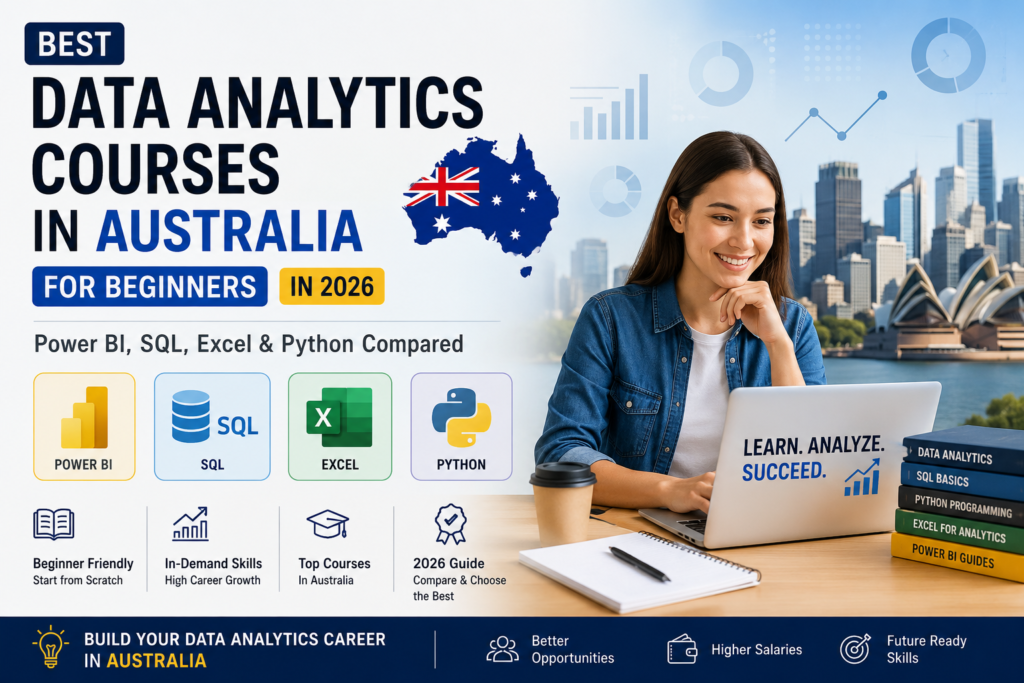
Best Data Analytics Courses in Australia for Beginners in 2026: Power BI, SQL, Excel & Python Compared
If you’re searching for the right data analytics courses in Australia, you’ve landed in the right place. Australia’s job market is evolving fast across healthcare, finance, retail, and government, employers are actively seeking professionals who can turn raw data into clear business decisions. Data analytics skills are no longer a niche specialism; they’re a mainstream career advantage.
This guide is written specifically for beginners with no prior technical experience. We’ve compared the four most in-demand tools used in Australian data analytics courses: Power BI, SQL, Excel, and Python. You’ll find clear, practical advice on which path suits your background, what you’ll realistically achieve, and where to start.
Quick Comparison of the Best Beginner Data Analytics Courses in Australia
Use this table to compare data analytics courses in Australia at a glance and find the path that matches your goals, background, and learning style.
| Course / Path | Best For | Skill Focus | Level | Delivery | Duration | Price | Certificate |
| Power BI Fundamentals | Visual learners | Dashboards, Reports | Beginner | Online | 4–8 wks | Free–$450 | Yes |
| SQL for Data Analysis | Logic thinkers | Querying, Databases | Beginner | Online/In-person | 4–6 wks | Free–$600 | Yes |
| Excel for Data Analysis | Office workers | Spreadsheets, Pivot | Absolute beginner | Online/In-person | 2–6 wks | Free–$400 | Yes |
| Python for Data Analytics | Career changers | Automation, ML basics | Some coding helps | Online | 8–16 wks | Free–$800 | Yes |
How We Chose the Best Data Analytics Courses for Beginners
Not all data analytics courses in Australia are created equal. We evaluated each learning path against six criteria to ensure genuine value for Australian beginners:
- Beginner-Friendliness: Does the course assume zero prior experience? Can a non-technical learner follow along and succeed without a background in maths or coding?
- Practical Skills: Does the course teach real, job-ready skills not just theory? Are learners building actual dashboards, running real queries, or writing working code?
- Tool Relevance: Is the tool widely used in Australian workplaces? Job data from SEEK and LinkedIn informed our selections, with a focus on what employers in Melbourne, Sydney, Brisbane, and Perth are actively requesting.
- Flexibility: Can learners study at their own pace, around work or family commitments? We prioritised courses with strong online and self-paced options.
- Certification Pathways: Does the course lead to a recognised credential that adds genuine value to your resume in the Australian job market?
- Australian Relevance: Does the content reflect Australian workplace tools, compliance environments, and industry contexts?
Best Data Analytics Learning Paths for Beginners in Australia
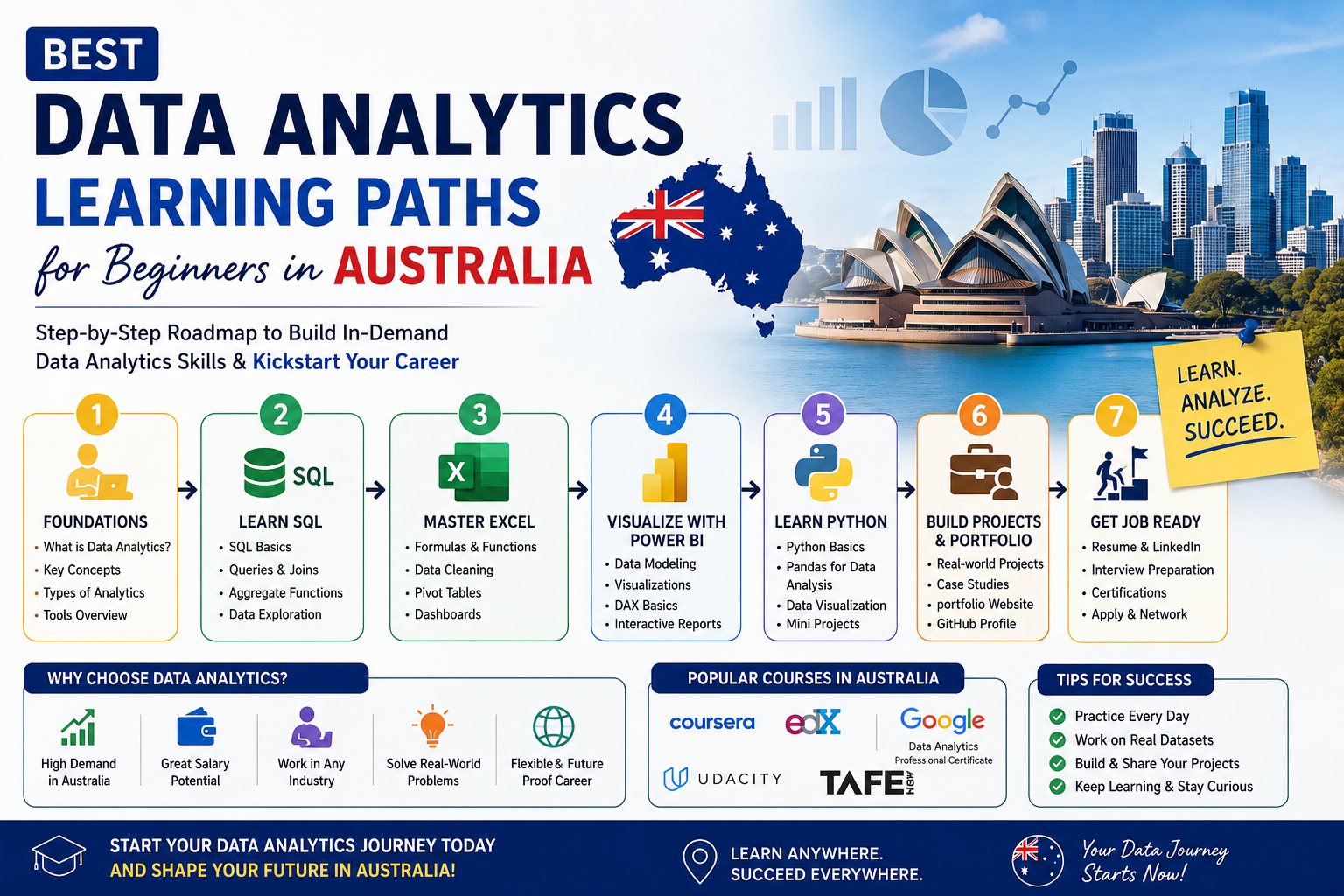
Each of the four tools below represents a distinct pathway into data analytics in Australia. Read through each to find the one that aligns with your starting point, career goals, and preferred way of working.
Power BI Fundamentals: Best Data Analytics Course for Visual Reporting
Best for visual reporting and interactive dashboards
Power BI is one of the most in-demand tools covered in data analytics courses across Australia. Built by Microsoft and deeply integrated with the Office 365 tools Australian organisations already rely on, it allows beginners to connect data sources, clean data with Power Query, and build professional dashboards often within a few days of starting.
What You’ll Learn
- Connecting to data sources including Excel, SharePoint, and SQL databases
- Transforming and cleaning data using Power Query
- Building interactive dashboards and reports for business stakeholders
- Creating calculated columns and measures using DAX (Data Analysis Expressions)
- Publishing and sharing reports via the Power BI Service
Who It Suits
Power BI is ideal for office workers, finance professionals, and anyone comfortable with Microsoft 365. If your role involves producing reports or presenting data, a Power BI data analytics course will have immediate, visible impact on your work and your career prospects. Our Power BI Fundamentals course is designed specifically for Australian beginners.
Pros
- Visually rewarding you’ll produce impressive dashboards quickly
- Deeply integrated with Microsoft Office tools Australians already use
- High demand across corporate, government, and healthcare sectors in Australia
- Free desktop version available low barrier to get started
Cons
- DAX formulas can be complex for absolute beginners
- Best features require a paid Microsoft 365 subscription
- Less suited to heavy data transformation SQL or Python may be needed for complex tasks
SQL for Data Analysis: Best Data Analytics Course for Working with Databases
Best for querying and working with business databases
SQL (Structured Query Language) is the backbone of modern data analytics. Almost every data analytics course in Australia that prepares learners for analyst roles includes SQL because almost every company that stores business data uses a relational database that SQL can query.
What You’ll Learn
- Core SQL syntax: SELECT, FROM, WHERE, GROUP BY, ORDER BY
- Joining multiple tables to answer complex business questions
- Filtering, aggregating, and summarising large datasets
- Writing subqueries and using window functions
- Working with databases like PostgreSQL, MySQL, and SQL Server
Who It Suits
SQL suits learners in operations, business intelligence, marketing analytics, and finance whose data lives in a company database. It’s also the most logical first step for anyone targeting a dedicated data analyst role. Our SQL for Data Analysis – Beginner course is built for Australian workplace contexts and assumes no prior coding experience.
Pros
- Universal skill almost every analytics role in Australia requires some SQL
- Highly transferable across industries and tools
- Free tools available (PostgreSQL, DBeaver, SQLite) for practice
- Strong return on investment for entry-level analyst positions
Cons
- Primarily text-based less visual than Power BI or Excel
- Requires a database environment to practise (though free options exist)
- Doesn’t cover visualisation typically combined with Power BI or Python
Excel for Data Analysis: Best Data Analytics Course for Office-Based Roles
Best for spreadsheets, reporting, and office-based analysis
Excel is the most universally used tool across data analytics courses in Australia and for good reason. It’s already installed on most Australian work computers, it’s highly intuitive for beginners, and the skills it builds are immediately applicable in virtually every role and industry.
What You’ll Learn
- Advanced formulas: VLOOKUP, INDEX/MATCH, SUMIFS, COUNTIFS
- Pivot Tables and Pivot Charts for summarising large datasets
- Data cleaning and transformation techniques
- Conditional formatting and data validation
- Introduction to Power Query within Excel as a bridge to Power BI
Who It Suits
Excel suits beginners in administration, HR, finance, project management, or any role involving spreadsheets. A well-structured Excel data analytics course will deliver practical value within days and provides an ideal foundation for progressing to Power BI and SQL.
Pros
- Already installed on most Australian work computers no setup required
- Fastest path from beginner to immediate productivity
- Extremely broad job market applicability across all sectors
- Strong foundation for advancing to Power BI and SQL
Cons
- Not ideal for very large datasets exceeding one million rows
- Manual, file-based workflows can be slow and error-prone
- Not seen as a specialist analytics skill in dedicated data analyst roles
Python for Data Analytics: Best Course for Automation and Advanced Analysis
Best for automation, scalable analysis, and long-term career growth
Python is the language of modern data science and is increasingly featured in advanced data analytics courses in Australia. It takes longer to learn than other tools, but it offers the greatest long-term capability from automating reports to building machine learning models.
What You’ll Learn
- Python fundamentals: variables, loops, functions, and data types
- Data manipulation with Pandas Python’s Excel equivalent
- Data visualisation with Matplotlib and Seaborn
- Automating repetitive data tasks and reports
- Introduction to statistical analysis and basic machine learning concepts
Who It Suits
Python is best suited to career changers, graduates, and technically curious learners aiming for roles in data science, machine learning, or advanced analytics. If you’re targeting the highest-paying data roles in Australia, Python is the most future-proof skill you can develop.
Pros
- Most versatile analytics tool from simple analysis to AI and machine learning
- Massive global and Australian community with extensive free resources
- Automates tasks that would take hours in Excel
- Highly valued in technology, research, finance, and government sectors
Cons
- Steeper learning curve than other tools expect to invest more time upfront
- Requires a coding mindset that some beginners find initially challenging
- Slower to produce visual outputs compared to Power BI
Which Tool Should Beginners Learn First: Excel, SQL, Power BI or Python?
This is the most common question beginners ask when comparing data analytics courses in Australia. The right starting point depends on your current role and career direction. Here’s a simple, practical framework:
| → Start with Excel if…
You’re completely new to data and work in an office environment. Excel builds the foundational data literacy formulas, logic, and data structure that makes every other tool easier to learn. |
| → Start with Power BI if…
You already use Microsoft 365 and want to create impressive reports quickly. Power BI delivers visible wins fast, and skills are highly valued in Australian corporate, government, and healthcare organisations. |
| → Start with SQL if…
You want a job-ready analytical skill applicable to almost every data analyst role in Australia. SQL is used in virtually every industry that stores business data from retail to banking to government. |
| → Start with Python if…
You’re planning a full career change into data science or want maximum long-term capability. Python requires more commitment upfront but opens the widest range of high-value opportunities. |
For most Australian beginners, the recommended progression is: Excel → Power BI → SQL → Python.
Best Data Analytics Courses in Australia by Career Goal
Different roles need different skills. Use this table to match your career goal to the most effective learning path in Australian data analytics courses:
| Career Goal | Recommended Path | Why It Works |
| Office / Admin Roles | Excel → Power BI | Immediate workplace application |
| BI / Reporting Roles | Power BI → SQL | Strong demand in Australian job market |
| Entry-Level Analysts | SQL → Python | Broad, employer-valued foundation |
| Career Changers | Python → SQL | Future-proof, high earning potential |
Free vs Paid Data Analytics Courses in Australia
You don’t need to spend thousands to build strong data analytics skills. Australia has access to a wide range of free and affordable learning options. Here’s how to think about the tradeoffs between free and paid data analytics courses:
Free Options
- Microsoft Learn — Free Power BI and Excel modules direct from Microsoft, including pathway certifications
- Google Data Analytics Certificate on Coursera — Frequently available with financial aid for Australian learners
- W3Schools SQL Tutorial — Free, beginner-friendly SQL reference and practice environment
- Kaggle Learn — Free Python for Data Analytics courses with hands-on notebooks
- YouTube — Thousands of hours of beginner-friendly tutorials across all four tools, completely free
Paid Options
- Udemy — Regularly discounted to AUD $15–25. Excellent value for Power BI, SQL, and Python courses
- LinkedIn Learning — Monthly subscription with a library of relevant courses; often included with LinkedIn Premium
- TAFE NSW / Victoria / Queensland — Government-subsidised short courses in digital and data skills
- Data Analytics Courses Australia — Industry-led, structured training in Power BI, SQL, Azure and more, with certification pathways
Our recommendation: Start free to confirm your interest, then invest in a structured paid course once you’re committed to a specific tool or career path. Certifications from recognised providers add genuine credibility on Australian resumes.
Can You Learn Data Analytics Online in Melbourne, Sydney, Brisbane, Perth, Adelaide or Canberra?
Absolutely. Every major Australian city has excellent access to data analytics courses, and most of the best options are fully remote and self-paced. We offer in-person and online data analytics training across Australia—here’s what to know about each city’s data landscape:
- Melbourne: Strong demand for data analytics skills in finance, healthcare, and government. Power BI and SQL are particularly in-demand in Melbourne’s corporate sector. TAFE Victoria also offers subsidised digital skills programs.
- Sydney: Australia’s largest job market for data analysts. SQL and Python are highly sought after in Sydney’s fintech, consulting, and media sectors. Multiple short-course providers and bootcamps operate here.
- Brisbane: A growing tech sector with strong demand for Power BI and Excel analysts. Queensland Government subsidised training programs can significantly reduce data analytics course costs.
- Perth: Mining, resources, and logistics sectors drive demand for data professionals. Excel and SQL are widely used in operational Perth roles. Online learning is particularly common given geographic spread.
- Adelaide: Strong government and defence sector with growing data literacy initiatives. TAFE SA offers relevant short courses. Excel and Power BI are most commonly required in Adelaide roles.
- Canberra: The public sector dominates—and data analytics skills are increasingly required across APS roles. Power BI is particularly common in Canberra’s government reporting contexts.
Wherever you are in Australia, online data analytics courses level the playing field. You have access to the same quality training, certifications, and community resources as learners anywhere in the world. View all course locations.
Frequently Asked Questions About Data Analytics Courses in Australia
What is the best data analytics course for beginners in Australia?
The best course depends on your starting point and goals. For most beginners, a Power BI Fundamentals or Excel for Data Analysis course offers the fastest path to practical, job-ready skills. If you’re planning a career change into a dedicated analyst role, an SQL course will give you the most transferable and in-demand capabilities in the Australian job market. Browse our full range of data analytics courses in Australia to compare options.
Do I need Python to become a data analyst in Australia?
Not necessarily. Many successful data analysts across Australian organisations use Excel, Power BI, and SQL without writing a line of Python. That said, Python significantly expands your capability and earning potential over time—particularly in more technical or senior analytics roles. It’s worth learning eventually, but not essential on day one.
Should I learn Excel or SQL first?
If you work in an office environment and use spreadsheets regularly, start with Excel—the skills are immediately applicable and build strong data intuition. If you’re aiming for a dedicated data analyst role, SQL is the more strategically valuable first step. Both skills are highly complementary and frequently required together in Australian data analytics job descriptions.
Is Power BI enough to get a data analytics job in Australia?
Yes, for many roles. Power BI is a complete, professional-grade analytics tool that is in high demand across Australian organisations—from ASX-listed companies to government agencies. A solid grounding in Power BI fundamentals is more than enough to secure entry-level BI analyst and reporting roles. Our Power BI Fundamentals course is designed to take you there.
Are online data analytics courses worth it?
Yes—when chosen carefully. High-quality data analytics courses online deliver the same skills as classroom training, often at a fraction of the cost. The key is choosing a course with hands-on practice (not just videos), a recognised certificate, and clear practical outcomes. Pair any course with personal projects or real workplace application, and you’ll stand out to Australian employers. For structured, industry-led training with certification, explore our range of data analytics courses across Australia.
Conclusion: Start Your Data Analytics Journey in Australia Today
Data analytics skills are no longer optional in the modern Australian workforce—they’re a genuine competitive advantage that opens doors across every industry and career level.
Whether you choose to start with the familiar comfort of Excel, the visual impact of Power BI, the database power of SQL, or the long-term versatility of Python, you’re making an investment that will pay dividends throughout your career.
For most Australian beginners, the clearest path is: Excel → Power BI → SQL → Python. Start where you are, build confidence with practical wins, and layer in new skills as your ambitions grow. The best time to start is now.
| 🚀 Ready to Get Started?
Explore our full range of data analytics courses in Australia — including Power BI, SQL, Azure, and more. Flexible online and in-person options available across Melbourne, Sydney, Brisbane, Perth, Adelaide, and Canberra. Browse data analytics courses → |