
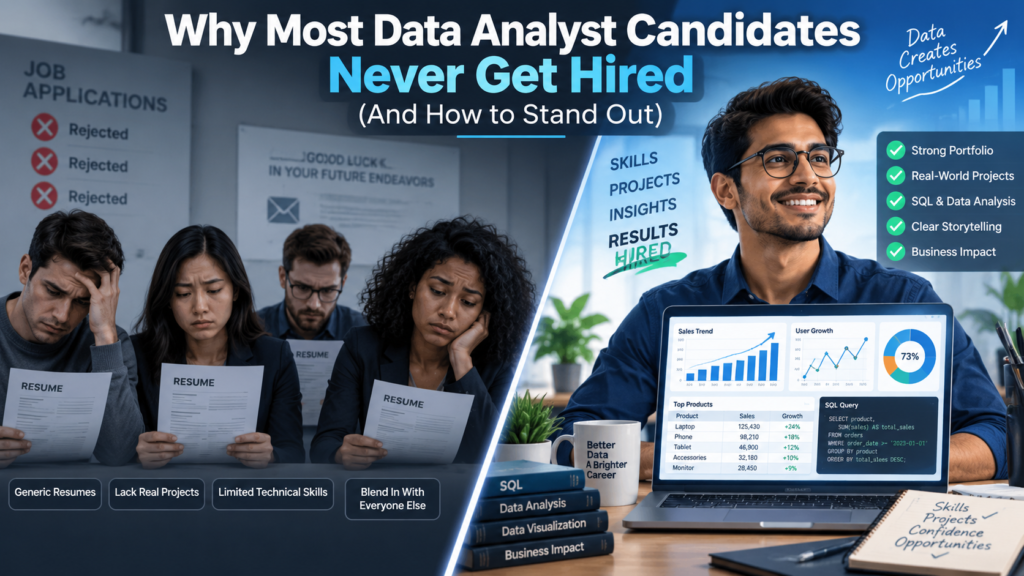
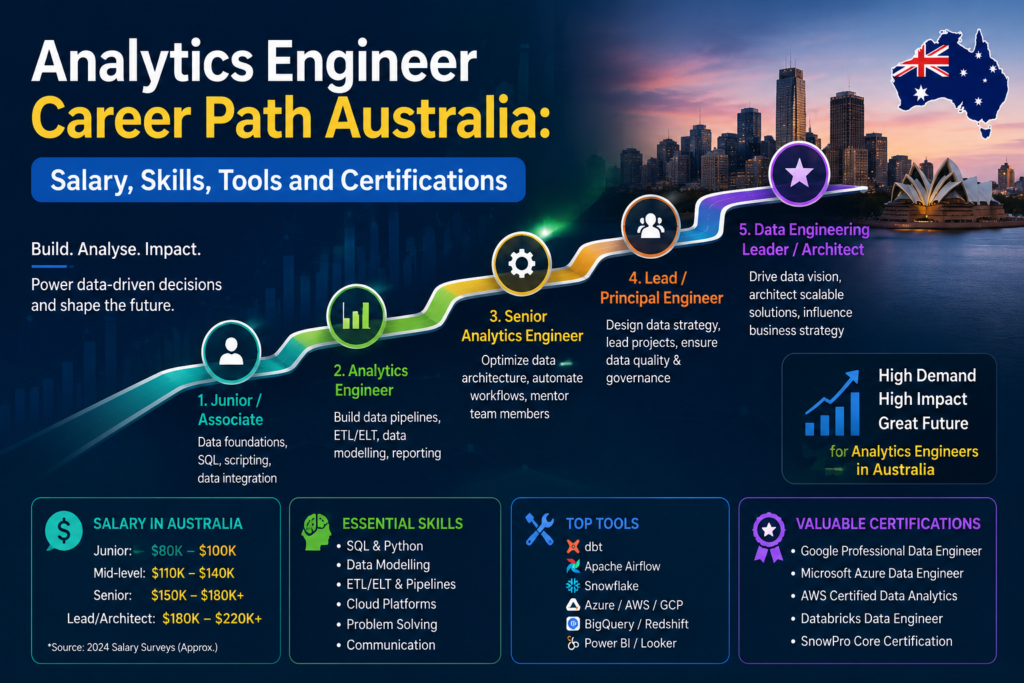

Why data analyst candidates don’t get hired is one of the most searched questions among job seekers in Australia right now and the honest answer has very little to do with luck. Every week, hundreds of resumes land on the desks of hiring managers in Sydney, Melbourne, Brisbane, Perth, Adelaide and Canberra, yet only a small fraction of applicants make it past the first screening call. Most candidates have a certificate, a resume full of buzzwords, and genuine enthusiasm for data but they still get rejected, often without ever knowing exactly why.
The truth is that hiring managers aren’t rejecting people because data analytics is oversaturated. They’re rejecting candidates who can’t prove, in a practical way, that they can turn raw data into a decision a business can act on. This guide breaks down the real reasons Australian data analyst candidates get overlooked in 2026, and the specific, practical steps you can take to become the candidate who gets the offer instead of the rejection email.
1. They Treat Certifications as the Finish Line, Not the Starting Point
A certificate proves you can pass an exam. It does not prove you can sit in front of messy, real-world data and produce something a manager trusts. Recruiters across Melbourne and Sydney consistently report the same pattern: candidates list Power BI, SQL, and Excel on their resume, but freeze the moment they’re asked to walk through how they actually built a dashboard or cleaned a dataset.
This is why structured, project-based training matters more than theory alone. Courses like the Data Analytics Certification training at dataanalyticscourses.au are built around applied exercises rather than just exam prep, so graduates leave with real dashboards and case studies they can talk through confidently in an interview.
2. No Portfolio, No Proof
Hiring managers in every Australian capital city now expect at least one portfolio piece before they’ll book an interview. A portfolio doesn’t need to be elaborate a single well-documented project that shows the full journey from raw data to a clear business recommendation is worth more than five certificates with nothing to back them up.
What a hireable portfolio actually needs
- A real (or realistic) dataset sales, HR, healthcare, retail, or logistics data works well
- Visible data cleaning steps, not just a polished final chart
- At least one interactive Power BI or Tableau dashboard
- A short write-up explaining the business question and the recommendation you made from the data
- SQL queries you wrote yourself, not copied from a tutorial
If Power BI is the gap in your portfolio, the Power BI training at powerbicourse.au is specifically designed to help candidates in Sydney, Melbourne, Brisbane and Perth build the dashboard-building skills employers now ask for by name in job ads.
3. Weak SQL Skills Under Pressure
SQL is still the single most common technical filter used by employers hiring data analysts in Australia, according to job-posting data tracked by SEEK and the Australian Bureau of Statistics on the growth of data-related occupations. Candidates who can recite SQL syntax but freeze when asked to write a live query joins, subqueries, window functions during a technical screen are one of the most common reasons data analyst candidates get rejected before the final round.
The fix is deliberate, repeated practice writing SQL against messy datasets under mild time pressure, not just reading through syntax guides. Practising out loud, the way you would in a live technical interview, closes this gap faster than passive study.
4. Cloud and Platform Knowledge Is Now Expected, Not Optional
Australian employers increasingly expect data analysts to understand how data moves through cloud platforms, even in analyst-level roles. Candidates who can speak to Azure fundamentals — data storage, basic pipelines, and how BI tools connect to cloud data stand out immediately from candidates who only know desktop tools. The Azure Data Fundamentals and certification pathway at azurecertifications.au is a common next step for graduates in Adelaide and Canberra who want to close this gap and speak confidently about cloud data in interviews.
5. Resumes Full of Tools, Empty of Impact
Most rejected resumes list tools Excel, Power BI, SQL, Python without a single measurable outcome attached to them. Hiring managers skim resumes in seconds, and a list of software names tells them nothing about what you actually did with those tools.
Before and after: turning a tool list into proof of impact
- Weak: “Proficient in Excel, Power BI and SQL”
- Strong: “Built a Power BI sales dashboard that helped a retail team identify a 12% drop in regional sales and reallocate stock accordingly”
- Weak: “Experience with data cleaning”
- Strong: “Cleaned and standardised a 40,000-row customer dataset, removing duplicate records that were inflating reporting numbers by 8%”
Every bullet point on a data analyst resume should answer one question: what changed because of the work you did? If a line doesn’t answer that, rewrite it or remove it.
6. No Story for the Behavioural Interview
Technical skill gets you the interview; communication gets you the offer. Candidates in Brisbane, Perth and Adelaide regularly pass the technical screen and then stumble on questions like “walk me through a time you found something unexpected in the data.” Practising 2–3 clear stories using a simple structure situation, what you analysed, what you found, what changed as a result — makes this part of the interview far less stressful and far more convincing.
7. Applying Everywhere Instead of Applying Strategically
Mass-applying to every listed data analyst role, regardless of fit, wastes time and produces generic applications that hiring managers can spot immediately. Candidates who research the employer, tailor two or three resume bullet points to the specific job ad, and mention the actual business problem the company is likely trying to solve consistently get more callbacks than candidates who send the same resume to fifty companies unchanged.
How to Stand Out as a Data Analyst Candidate in Australia
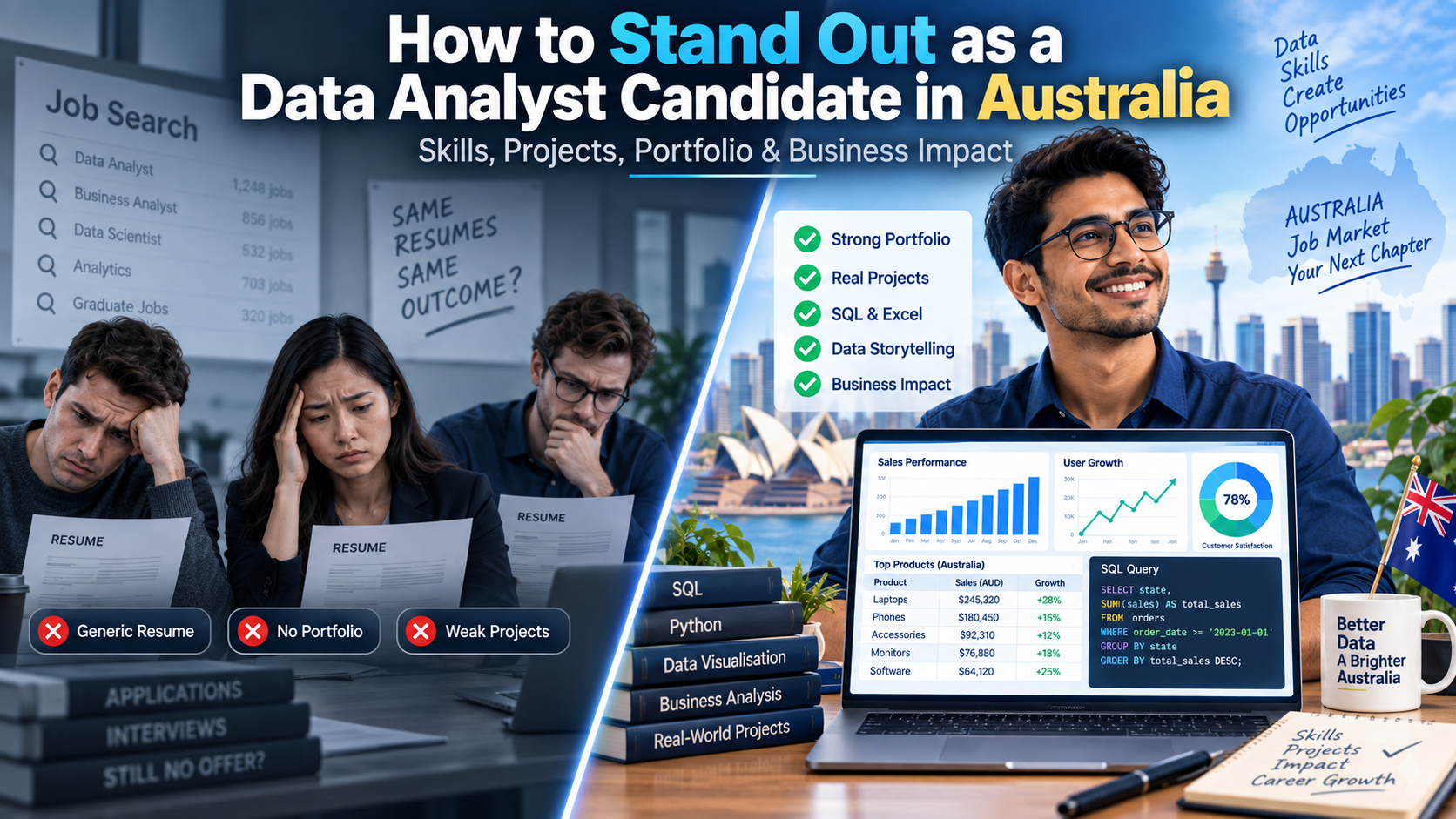
| What Rejected Candidates Do | What Hired Candidates Do |
| List certificates with no projects | Show 1–2 complete, documented portfolio projects |
| Memorise SQL syntax | Practise writing live SQL against real datasets |
| Ignore cloud/Azure basics | Can explain how data flows through a cloud platform |
| List tools on the resume | Attach a measurable outcome to every bullet point |
| Apply to every job listed | Apply to fewer, better-matched roles with tailored resumes |
Frequently Asked Questions
Why do data analyst candidates get rejected even with a certification?
Because a certification proves knowledge, not applied skill. Employers want to see a portfolio, live SQL ability, and clear communication not just a certificate on a resume.
What is the biggest skill gap for data analyst jobs in Australia right now?
Employer feedback consistently points to two gaps: confident, live SQL ability and basic cloud/Azure data knowledge, alongside the ability to build a genuine Power BI dashboard rather than a template.
How long does it take to become job-ready as a data analyst?
Most career changers who follow a structured, project-based course and build a portfolio become interview-ready within 3–6 months, depending on prior experience with SQL and Excel.
Final Thoughts
Most data analyst candidates don’t get hired because they stop at theory instead of building proof. The candidates who get offers in Sydney, Melbourne, Brisbane, Perth, Adelaide and Canberra are the ones who pair a recognised certification with a real portfolio, confident SQL skills, basic cloud knowledge, and a resume built around outcomes rather than tool names.
If you’re starting from scratch, Logitrain offers the certification pathway, and the dataanalyticscourses.au, powerbicourse.au and azurecertifications.au microsites cover the practical skills — dashboards, SQL, and cloud fundamentals that hiring managers say most candidates are missing.