


Data Analyst vs Data Engineer is one of the most common career questions in Australia’s data job market right now, and the honest short answer is: data engineers earn more on average, often by $25,000 to $35,000 a year. But the full picture is more interesting than a single number, because the two roles require different skills, suit different personality types, and lead to different long-term career ceilings. This guide compares Data Analyst vs Data Engineer salaries using current 2026 Australian data, then breaks down which path might actually suit you better regardless of the pay gap.
Data Analyst vs Data Engineer: What Each Role Actually Does
What a Data Analyst Does Day to Day
A data analyst takes existing data and turns it into insight building dashboards in Power BI or Tableau, writing SQL queries to answer business questions, and presenting findings to stakeholders who aren’t technical. The role sits closer to the business side of the Data Analyst vs Data Engineer comparison, with communication and storytelling skills mattering almost as much as technical ones.
What a Data Engineer Does Day to Day
A data engineer builds and maintains the infrastructure that makes analysis possible in the first place: pipelines that move data from source systems into a warehouse, transformation jobs that clean and structure it, and the underlying architecture that keeps everything reliable at scale. In the Data Analyst vs Data Engineer split, this role sits closer to software engineering, with tools like Python, Spark, Airflow and cloud data platforms (Azure, AWS, Snowflake) at the centre of the job.
Data Analyst vs Data Engineer Salary in Australia (2026 Figures)
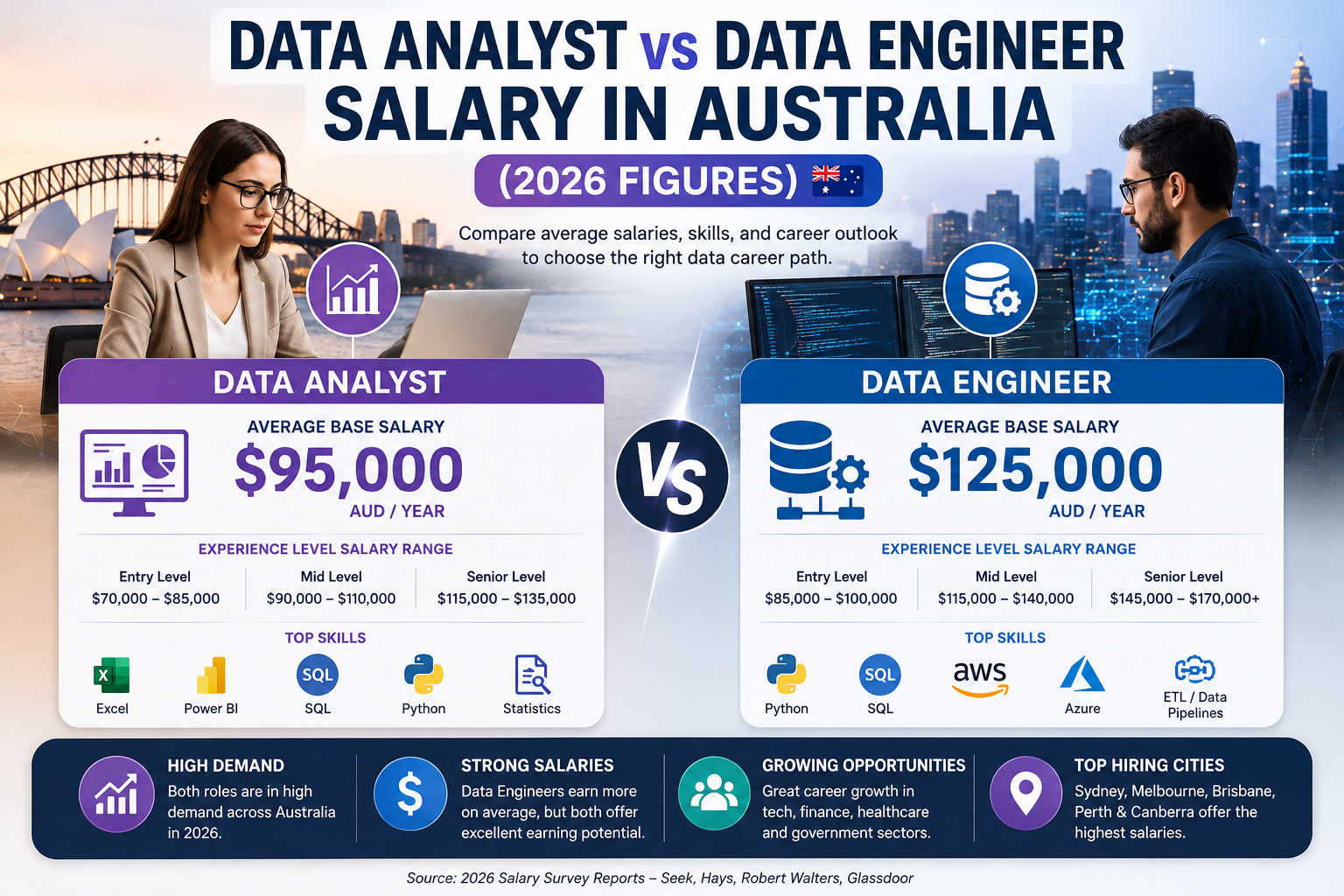
According to SEEK’s 2026 salary data, the average Data Analyst salary in Australia sits between $95,000 and $115,000 per year. SEEK’s Data Engineer salary data shows a notably higher range of $125,000 to $145,000 per year for the same period a gap of roughly $25,000 to $30,000 in favour of data engineers nationally.
| Level | Data Analyst (AUD) | Data Engineer (AUD) |
| Entry-level | $60,000 – $75,000 | $75,000 – $95,000 |
| Mid-level | $90,000 – $110,000 | $115,000 – $140,000 |
| Senior / Lead | $110,000 – $130,000 | $145,000 – $180,000+ |
Glassdoor’s 2026 figures broadly agree with this pattern, placing the Australian Data Engineer median salary around $126,000 compared with roughly $108,000 for data analysts confirming that whichever source you check, the Data Analyst vs Data Engineer pay gap consistently favours data engineers.
Why Data Engineers Earn More Than Data Analysts in Australia
The Data Analyst vs Data Engineer pay gap mostly comes down to supply, technical depth, and business risk. Data engineering requires stronger software engineering fundamentals coding, system design, cloud architecture which fewer candidates can do well, keeping supply tighter relative to demand. Data engineers also sit further upstream: if their pipelines break, every dashboard, report and machine learning model downstream breaks with them, which raises the perceived risk and value of the role in the eyes of employers.
Data Analyst vs Data Engineer: Skills and Tools Compared
- Data Analyst core tools: Excel, SQL, Power BI, Tableau, basic Python or R for analysis.
- Data Engineer core tools: Python, SQL at an advanced level, Spark, Airflow, dbt, cloud platforms like Azure or AWS.
- Data Analyst strengths: business communication, data visualisation, stakeholder reporting.
- Data Engineer strengths: software engineering, distributed systems, data architecture and pipeline reliability.
Career Progression: Long-Term Earning Potential
Both sides of the Data Analyst vs Data Engineer debate offer strong long-term progression, but the paths look different. Data analysts often progress into senior analyst, analytics manager, or pivot into data science or product roles once they build stronger statistical and coding skills. Data engineers typically progress into senior/staff data engineer, data architect, or platform engineering leadership roles, where senior salaries in Sydney and Melbourne can exceed $180,000 base. Neither path is a ceiling many senior data engineers started as data analysts and upskilled into engineering once they saw the pay and demand difference firsthand.
Which Career Path Should You Choose?
- Enjoy explaining insights to non-technical stakeholders and building dashboards → Data Analyst
- Enjoy writing code, solving system-level problems, and working with infrastructure → Data Engineer
- Want the fastest, lowest-barrier entry into the data industry → Data Analyst
- Willing to invest more time upfront in coding and cloud skills for a higher long-term ceiling → Data Engineer
- Not sure yet → many professionals start as a Data Analyst and transition into Data Engineering once core SQL and Python skills are solid
Real-World Example: Switching from Data Analyst to Data Engineer
Consider a Data Analyst working in Sydney’s financial services sector earning $100,000 who spends evenings learning Python, cloud fundamentals and data pipeline tools. Within 18 months, that same professional moves into a junior Data Engineer role starting closer to $120,000 a jump directly reflecting the Data Analyst vs Data Engineer salary gap discussed throughout this guide. This same pattern of analysts upskilling into engineering roles is playing out across Melbourne, Brisbane, Perth, Adelaide and Canberra, wherever demand for cloud data infrastructure keeps growing faster than the supply of qualified engineers.
How to Start a Career as a Data Analyst or Data Engineer
If you’re leaning towards the analyst path, start with our SQL for Data Analysis (Beginner) course and the Power BI Fundamentals course, then build toward the PL-300 (Microsoft Certified Power BI Data Analyst Associate) credential most Australian employers recognise. For a deeper look at typical earnings by city and experience, see our full Data Analyst Salary Australia guide and Data Analyst Career Roadmap.
If the Data Engineer path appeals more, our Azure Data Fundamentals course and Microsoft DP-605 (Fabric Analytics Engineer) build the cloud and pipeline foundations engineering roles require. Courses are available online or in person across Sydney, Melbourne, Brisbane and Perth. Browse more comparisons like this on our blog, or speak to a course advisor about which path fits your goals.
FAQs: Data Analyst vs Data Engineer
Is a Data Engineer harder to become than a Data Analyst?
Generally yes Data Engineer roles require stronger coding and system design skills, which usually takes longer to build than core Data Analyst skills.
Can a Data Analyst become a Data Engineer?
Yes, it’s a common and realistic transition once you strengthen Python, advanced SQL and cloud platform skills.
Which role has more job openings in Australia?
Data Analyst roles are generally more numerous and beginner-friendly, while Data Engineer roles are fewer but consistently higher paid due to skill scarcity.
Do I need a degree for either role?
No. Many professionals in both Data Analyst and Data Engineer roles in Australia come from certification-based or bootcamp-style training rather than a traditional degree.
Final Thoughts
On pure salary, the Data Analyst vs Data Engineer comparison has a clear winner: data engineers earn more, both starting out and at senior level. But “pays more” shouldn’t be the only factor the best career choice is the one that matches how you like to work day to day. If you want tailored advice on which certification path fits your goals and timeline, explore our full course catalogue or contact our team for a free career conversation.