



Data analyst salary Australia figures are rising fast and 2026 is shaping up to be the best year yet for data professionals across the country. Businesses in Sydney, Melbourne, Brisbane, Perth, and Adelaide are all actively competing for skilled data analysts, and salaries are responding accordingly.
Whether you are exploring a career change, just graduating, or looking to benchmark your current pay, this guide gives you everything you need. We cover salary ranges by experience level, a city-by-city breakdown, the skills that boost your earning potential, and the clearest path to launching your data analytics career in Australia.
Let’s dive into what the numbers actually look like for data analytics jobs Australia in 2026.
Average Data Analyst Salary in Australia for 2026
The average data analyst salary Australia in 2026 sits between $60,000 and $130,000+, depending on your experience level, city, and technical skill set. Here is what each level looks like:
| Experience Level | Salary Range (AUD) | Typical Roles |
| Entry-Level (0–2 yrs) | $60,000 – $75,000 | Junior Data Analyst, Reporting Analyst |
| Mid-Level (2–5 yrs) | $75,000 – $95,000 | Data Analyst, Business Analyst |
| Senior (5+ yrs) | $100,000 – $130,000+ | Senior Analyst, Lead Analyst, Analytics Manager |
- Entry-level roles focus on data cleaning, basic reporting, and dashboard support ideal for graduates and career changers.
- Mid-level analysts take ownership of data pipelines, stakeholder reporting, and visualisation tools like Power BI and Tableau.
- Senior analysts drive data strategy, manage junior team members, and command the highest data analyst pay Australia has to offer.
For live data analyst pay Australia figures, Seek Salary Insights and LinkedIn Salary update their data monthly and are excellent reference points when negotiating offers.
Data Analyst Salary by City in Australia Full Comparison
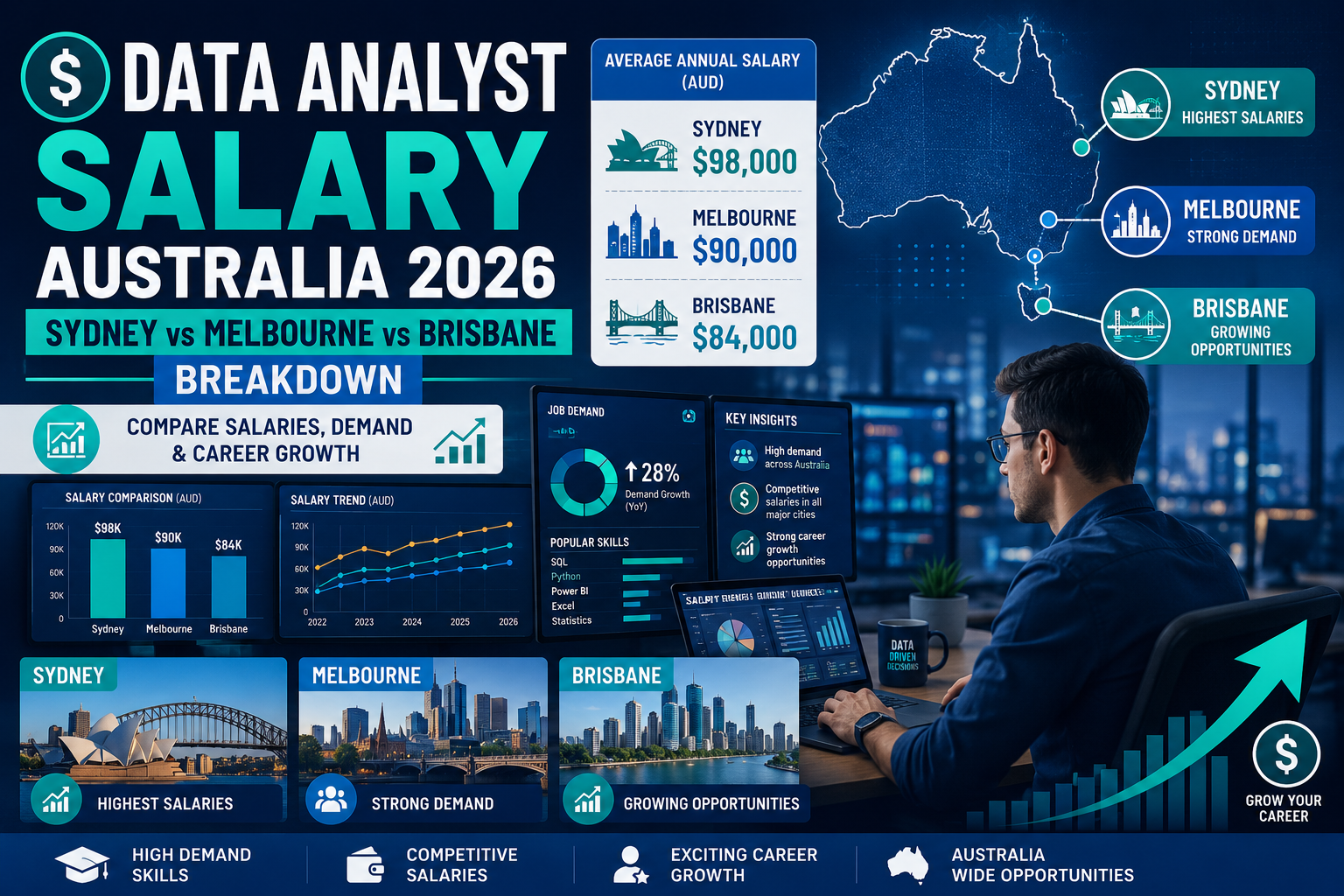
Where you work in Australia has a significant impact on what you earn. Here is a city-by-city summary, followed by a detailed breakdown of each market:
| City | Salary Range | Market Demand | Key Industries |
| Sydney | $80,000 – $110,000 | Highest | Finance, Tech, Consulting |
| Melbourne | $75,000 – $100,000 | Very Strong | Business, Government, Retail |
| Brisbane | $70,000 – $90,000 | Fast Growing | Resources, Infrastructure, Retail |
| Perth | $68,000 – $88,000 | Growing | Mining, Energy, Government |
| Adelaide | $65,000 – $85,000 | Emerging | Health, Defence, Education |
Data Analyst Salary in Sydney
Sydney consistently offers the highest data analyst salary Sydney in Australia. The concentration of financial services, multinational tech companies, and consulting firms means demand is relentless and salaries reflect that. Entry-level analysts in Sydney can expect to start around $80,000, with experienced professionals earning $95,000 to $110,000 and senior roles pushing well past that.
- Top hiring industries: banking, fintech, insurance, e-commerce, and management consulting.
- Major employers: Macquarie Group, Commonwealth Bank, Atlassian, Deloitte, and large government agencies.
- Sydney’s data analyst roles tend to require SQL and Python more frequently than other cities upskilling pays off quickly here.
Data Analyst Jobs in Melbourne
Melbourne has one of the strongest and most diverse data analyst jobs Melbourne markets in the country. Salaries typically range from $75,000 to $100,000, with mid-level professionals averaging around $84,000. Melbourne’s economy spans corporate services, government, retail, healthcare, and a growing tech startup scene.
- Melbourne’s state government is a major employer of data analysts, offering stable roles with competitive salary Melbourne packages and strong super.
- The city’s startup and scale-up scene increasingly values Python and cloud-based analytics skills at a premium.
- Power BI proficiency is particularly valued by Melbourne employers in the financial services and retail sectors.
Data Analyst Salary in Brisbane
Brisbane is one of the most exciting markets for data analyst salary Brisbane growth in 2026. Salaries range from $70,000 to $90,000, and demand is accelerating thanks to major infrastructure projects, population growth, and the 2032 Olympics preparation pipeline.
- Key sectors hiring data analysts in Brisbane: construction analytics, government reporting, logistics, and retail.
- Brisbane offers a meaningfully lower cost of living than Sydney; a $78,000 salary in Brisbane provides a comparable lifestyle to $90,000 in Sydney.
- Junior data analysts in Brisbane who add SQL and Power BI skills are seeing faster-than-average salary growth.
Data Analyst Salary in Perth and Adelaide
Both Perth and Adelaide are growing markets for data analytics in Australia, offering strong opportunities particularly for those willing to work in industry-specific sectors.
- Perth ($68,000 – $88,000): The resources and mining sector drives significant demand for operational and financial data analysis. Senior roles here are well-compensated due to high industry profitability.
- Adelaide ($65,000 – $85,000): Defence, healthcare, and education are the primary drivers of data analyst demand in Adelaide. The lower cost of living makes salaries here highly competitive in real terms.
Factors That Affect Data Analyst Salary in Australia
Not every data analyst earns the same. Here are the key variables that determine exactly where your data analyst salary Australia lands within the published ranges:
Experience Level
This is the single biggest salary lever. Each year of demonstrated, outcomes-focused experience typically adds $5,000 to $12,000 per year, especially when you can point to specific business improvements your data work delivered.
Technical Skills
Your data analytics skills Australia toolkit is the second biggest driver. Analysts with multiple complementary skills particularly SQL + Power BI or Python + Tableau consistently earn 15–25% more than those with only one core tool. We cover this in detail in the next section.
Industry
- Finance and banking: consistently the highest-paying sector for data analysts in Australia, particularly in Sydney and Melbourne.
- Technology and SaaS: competitive base salaries with performance bonuses and sometimes equity packages.
- Healthcare: growing rapidly, with strong government and private sector investment in data infrastructure.
- Retail and e-commerce: large volume of mid-level roles across all major Australian cities.
- Government: stable pay bands, strong superannuation, and excellent job security but salary ceilings can be lower than private sector.
Company Size and Maturity
Large ASX-listed companies and multinationals typically pay more than SMEs. However, growth-stage tech companies and startups sometimes offer equity or uncapped bonuses that exceed the base salary gap significantly.
Certifications and Portfolio
Practical certifications particularly in Power BI, SQL, and Python and a strong project portfolio now carry as much weight as formal degrees in Australian hiring decisions. Employers in Sydney, Melbourne, and Brisbane are increasingly skills-first in their screening process.
Top Skills That Increase Your Data Analyst Salary in Australia
If you want to earn more as a data analyst in Australia, skills are your fastest lever. Here is how each key data analyst skills demand area maps to real salary outcomes in the Australian job market:
| Skill | Salary Boost (Est.) | Demand Level in Australia |
| Excel (Advanced) | + $5,000 – $10,000 | Very High — required in almost all roles |
| SQL | + $8,000 – $15,000 | Essential — listed in 80%+ of job ads |
| Power BI / Tableau | + $10,000 – $18,000 | High — growing fast across all cities |
| Python | + $12,000 – $22,000 | High — opens senior and specialist roles |
| Machine Learning / AI | + $20,000+ | Specialist — rapidly increasing demand |
Excel — The Non-Negotiable Foundation
Every data analyst in Australia starts with Excel. PivotTables, Power Query, advanced formulas, and dashboard building are expected at even entry-level roles. Excel for data analysts Australia is not just a soft requirement — it is the baseline. Our Excel courses online give you a structured path from basics to job-ready advanced skills.
SQL — The Most In-Demand Skill
SQL is the language of data. More than 80% of data analyst job postings in Sydney, Melbourne, and Brisbane list SQL as a required skill. Even basic SQL — SELECT statements, filtering, joins, and aggregations — can add $8,000 to $15,000 to your salary compared to analysts without it.
Power BI and Tableau — Visualisation That Gets Attention
Interactive dashboard skills are in extremely high demand across Australian businesses right now. Power BI dominates corporate environments, while Tableau is widely used in finance and healthcare. Our Power BI course is built for professionals who want to build job-ready visualisation skills fast and stand out in any job interview in Australia.
Python — The Path to Senior Salaries
Python unlocks senior analyst and data science territory. Even basic scripting using Pandas and Matplotlib can add $12,000+ to your annual salary. If your goal is to reach $100,000+ as a data analyst in Australia, Python is the skill to add after SQL.
How to Become a Data Analyst in Australia Step by Step
You do not need a computer science degree to become data analyst Australia. Many of the most successful data analysts in Sydney, Melbourne, and Brisbane transitioned from finance, administration, marketing, and operations roles. Here is the most effective pathway in 2026:
- Master Excel Fundamentals — Excel is the universal starting point for data analytics in Australia. Focus on PivotTables, VLOOKUP/XLOOKUP, data cleaning, and basic charting. This alone qualifies you for junior data and reporting roles paying $60,000 to $70,000.
- Learn SQL — SQL lets you query databases directly and is listed in the majority of Australian data analyst job ads. Free resources like SQLZoo are a solid start; structured courses accelerate your learning significantly.
- Learn Power BI or Tableau — Pick one visualisation tool and build 2 to 3 portfolio dashboards. Hiring managers across Sydney, Melbourne, and Brisbane will ask you about this in every interview.
- Add Python (When Ready) — Python is not always required for entry-level roles, but it adds $12,000 to $22,000 to your earning potential. Libraries like Pandas, Matplotlib, and Seaborn are the most relevant for data analytics work.
- Build a Portfolio — Create 3 to 5 projects using real Australian datasets (ABS open data, Kaggle, or government data portals). A portfolio demonstrates practical skills far more convincingly than certificates alone.
- Enrol in Structured Training — Structured data analytics training Australia covers all tools in the right sequence and prepares you for the specific demands of the Australian job market. Most students go from beginner to job-ready in 3 to 6 months.
- Apply and Iterate — Tailor your resume to include specific tool names (Excel, SQL, Power BI) and quantified outcomes. Apply for junior roles and internships in your city, and refine your approach with each application.
Our data analytics courses Australia cover the full pathway from Excel through SQL, Power BI, and Python — all designed specifically for the Australian job market.
Best Way to Start Your Data Analytics Career in Australia
| 🎯 Ready to Launch Your Data Analytics Career? Enrol Today
Want to earn a high-paying data analyst salary in Australia? Our beginner-friendly data analytics course is built for real-world jobs in Sydney, Melbourne, Brisbane, Perth, and Adelaide. ✅ Complete pathway — Excel, SQL, Power BI, and Python in one structured program ✅ Practical projects using real Australian datasets ✅ Study online at your own pace — from anywhere in Australia ✅ Certificate of completion to add to your resume and LinkedIn ✅ Designed for career changers, graduates, and professionals upskilling Most students become job-ready for data analyst roles in 3 to 6 months with consistent weekly study. 👉 Enrol now and take your first step toward a $75,000 – $100,000+ data analyst salary in Australia. |
Final Thoughts: Is a Data Analyst Career in Australia Worth It in 2026?
Yes — and the data backs it up. Here is a quick summary of everything we have covered:
- Data analyst salary Australia figures are rising year on year as demand outpaces supply in every major city.
- Skills pay more than degrees — Excel, SQL, Power BI, and Python are what Australian employers are actively hiring for right now.
- Location matters — Sydney pays the most, but Melbourne, Brisbane, Perth, and Adelaide all offer strong opportunities with better lifestyle value.
- Career change is genuinely achievable — with structured training and a portfolio, most people are job-ready within 3 to 6 months.
Data analytics is one of the fastest-growing career fields in Australia and is listed as a critical skills shortage area by the Australian Government. The data analyst career Australia outlook through 2030 is exceptionally strong. If you have been thinking about making the move, 2026 is the year to act.
Frequently Asked Questions About Data Analyst Salary in Australia
Here are the most commonly searched questions about data analyst salaries and careers in Australia in 2026:
Q1: What is the average data analyst salary in Australia?
The average data analyst salary in Australia in 2026 ranges from $60,000 for entry-level roles to $95,000 for experienced mid-level analysts and $100,000 to $130,000+ for senior and lead positions. Exact figures vary significantly by city, industry, and technical skill set.
Q2: Which city in Australia pays the highest data analyst salary?
Sydney offers the highest data analyst salaries in Australia, with experienced analysts regularly earning $95,000 to $110,000. Melbourne is a close second, followed by Brisbane, Perth, and Adelaide.
Q3: Can beginners become data analysts in Australia?
Yes, absolutely. Many working data analysts in Sydney, Melbourne, and Brisbane started with no formal technical background. Starting with Excel and SQL, then adding Power BI or Python, is the most common and effective self-taught pathway. Most beginners are job-ready in 3 to 6 months with structured training.
Q4: How long does it take to become a data analyst in Australia?
With focused, structured data analytics training Australia, most people can become job-ready for entry-level data analyst roles within 3 to 6 months. The timeline depends on your current skills, the tools you focus on, and how consistently you practice on real datasets.
Q5: Which skills are required for data analyst jobs in Australia?
The core skills required for data analyst jobs Australia are Excel (advanced), SQL, Power BI or Tableau, and ideally Python. SQL and Excel are the most frequently listed in Australian job postings. Python and machine learning unlock senior roles and significantly higher pay.
Q6: Is data analytics a good career in Australia in 2026?
Yes — data analytics is one of the fastest-growing and highest-paying career fields in Australia right now. The Australian Government identifies data skills as a national shortage area, meaning strong demand and rising salaries are expected through 2030 and beyond